
- Published on
Waist vs. Waste: What Is the Difference?
- Authors

- Name
- Tony
- @shyeditor
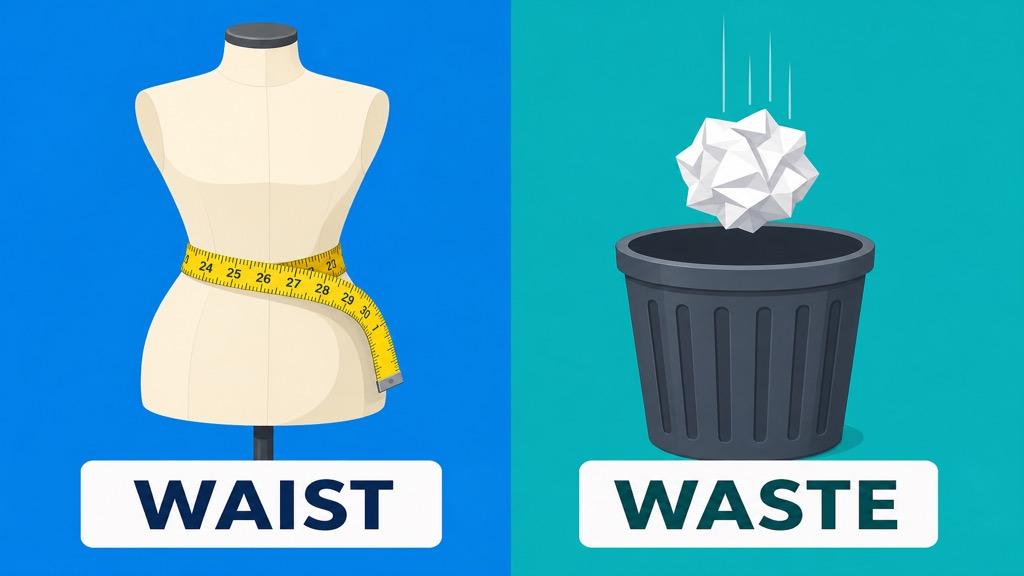
What Is the Difference Between Waist and Waste?
"Waist" is the part of your body between your ribs and your hips. "Waste" means to use something carelessly or needlessly, and as a noun it refers to discarded or unwanted material. The two words sound exactly the same but share no meanings.
- Waist: "The belt sat snugly at his waist." (Part of the body.)
- Waste (verb): "Don't waste your time." (Use carelessly.)
- Waste (noun): "The factory dumped its waste in the river." (Discarded material.)
The simple rule: "waist" with an "i" is the body part, and "waste" with an "e" is everything else.
Why Do People Confuse Waist and Waste?
The words are perfect homophones, pronounced identically, and they look very similar, differing only in the middle vowel. Because "waist" is the less common of the two, writers sometimes default to "waste" out of habit, producing errors like "the dress fit her waste." The fix is a quick memory cue that ties the spelling to the body part.
How Do You Use Waist Correctly?
"Waist" is always a noun referring to the narrowest part of the human torso, the area between the ribs and the hips. By extension, it can describe the corresponding part of a garment.
When Should You Use Waist in a Sentence?
Use "waist" whenever you mean the middle of the body or of clothing:
- "She tied the sweater around her waist."
- "These trousers are too tight at the waist."
- "The water rose up to his waist."
- "The dress nips in at the waist."
If you are talking about a body part or where a garment sits on the body, you want "waist" with an "i."
Does Waist Have Other Meanings?
A few specialized uses exist. The "waist" of a ship is the middle part of the upper deck, and the "waist" of a violin or guitar is the inward curve at the instrument's middle. All of these come from the same idea: the narrow midsection of something.
How Do You Use Waste Correctly?
"Waste" works as a verb meaning to use something carelessly or to no purpose, and as a noun meaning discarded material or the act of squandering. It can also be an adjective describing barren or unused land.
When Does Waste Mean to Use Carelessly?
Use "waste" (verb) when something is spent without good purpose:
- "Don't waste food."
- "We wasted an entire afternoon waiting."
- "He wasted his savings on the scheme."
- "Why waste energy arguing?"
When Does Waste Mean Discarded Material?
Use "waste" (noun) for trash, byproducts, or anything thrown away:
- "The city recycles its household waste."
- "Industrial waste polluted the stream."
- "Reducing food waste saves money."
When Is Waste Used to Describe Land?
"Waste" can also be an adjective or noun meaning barren, empty, or uncultivated land:
- "Nothing grew on that waste ground."
- "They crossed a frozen wasteland."
This sense survives in the phrase "lay waste to," meaning to devastate or ruin completely.
What Is the Easiest Way to Remember the Difference?
Remember that "waist" contains an "i," and you can point to "I" at your own waist. "Waste," with an "e," has no connection to the body, so use it for everything else: squandering, trash, and barren land.
Is There a Trick Based on the Spelling?
Yes. "Waist" hides the word "is" or the letter "I" in the middle, and you can put your hands on your waist as you say "this is my waist." For the other word, notice that "waste" rhymes with "taste," and you might "waste" food you do not want to "taste." Tying each spelling to a vivid image makes the right one easier to recall.
How Do You Handle These Words in Formal Writing?
In fashion writing, fitness content, environmental reporting, and fiction, the swap is an obvious error that distracts readers. "A belt around her waste" or "such a waist of time" jars anyone paying attention. When you describe characters or scenes precisely, small slips like this can undercut otherwise strong character description examples.
Can Grammar Tools Catch This Mistake?
A standard spell checker accepts both spellings as valid words, so it will not flag "waste" when you meant "waist." The error is contextual. ShyEditor reads the meaning of your sentence and flags when "waste" appears where you describe a body part, or when "waist" shows up where you clearly mean squandering or trash. If you are editing your own draft, our guide to how to edit your own writing pairs well with a tool that catches what tired eyes miss.
Quick Reference: Waist vs Waste
| Word | Meaning | Example |
|---|---|---|
| Waist | The midsection of the body | "A belt at the waist." |
| Waste (verb) | To use carelessly | "Don't waste time." |
| Waste (noun) | Discarded material | "Recycle the waste." |
| Waste (adjective) | Barren or unused | "Waste ground." |
Practice Sentences
Test yourself, which word is correct?
- "The tailor measured his _____ for the new suit." - waist (body part)
- "Try not to _____ paper when you print." - waste (use carelessly)
- "The river was polluted by chemical _____." - waste (discarded material)
- "The skirt was loose around her _____." - waist (body part)
- "Nothing could grow on that barren _____ land." - waste (barren)
Write With Confidence
Homophones like waist and waste sound identical but mean completely different things. ShyEditor catches these contextual slips before they reach the page, whether you are writing a novel, a fitness article, or an environmental report. Try it free: https://www.shyeditor.com