
- Published on
Emigrate vs. Immigrate: What Is the Difference?
- Authors

- Name
- Tony
- @shyeditor
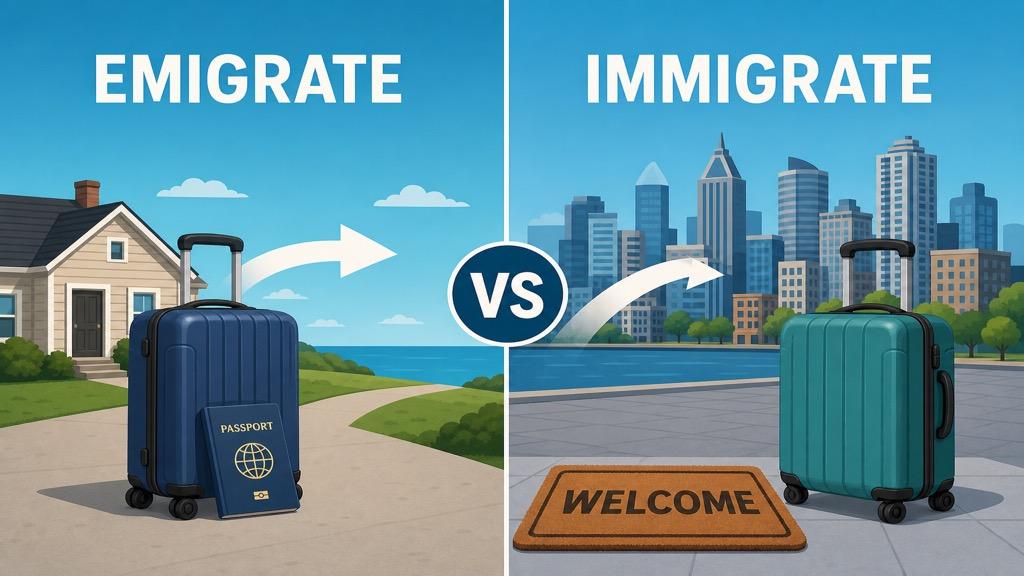
What Is the Difference Between Emigrate and Immigrate?
"Emigrate" means to leave your country of origin. "Immigrate" means to enter and settle in a new country. Both words describe the same act of relocating internationally, but from opposite perspectives. A person emigrates FROM one country and immigrates TO another.
- Emigrate: "She emigrated from Poland in 1995." (She left Poland.)
- Immigrate: "She immigrated to Canada in 1995." (She arrived in Canada.)
The same person, the same move, but "emigrate" focuses on departure and "immigrate" focuses on arrival.
Why Do People Confuse Emigrate and Immigrate?
The words look alike, sound alike, and describe the same event. The only difference is the direction of movement. It doesn't help that both words can technically be used in the same sentence about the same person: "She emigrated from Italy and immigrated to Australia." The prefixes hold the key: "e-" (out of) and "im-" (into).
How Do You Use Emigrate Correctly?
"Emigrate" means to leave a country permanently or for an extended period. The focus is on the departure, the place being left behind.
When Should You Use Emigrate in a Sentence?
Use "emigrate" when the emphasis is on the country someone is leaving. It almost always pairs with "from":
- "My grandparents emigrated from Ireland during the famine."
- "Thousands of engineers emigrate from the country every year."
- "He emigrated from South Korea at the age of twelve."
- "After the revolution, many families emigrated from the region."
What Preposition Goes With Emigrate?
"Emigrate" takes from. You emigrate FROM a place. Saying "emigrate to" is incorrect because emigrating is specifically about leaving:
- Correct: "They emigrated from Germany."
- Incorrect: "They emigrated to Germany."
If you want to emphasize where someone went, use "immigrate to" instead.
How Do You Use Immigrate Correctly?
"Immigrate" means to enter a new country with the intention of settling there permanently. The focus is on the destination, the place being entered.
When Should You Use Immigrate in a Sentence?
Use "immigrate" when the emphasis is on the country someone is entering. It pairs with "to" or "into":
- "Her family immigrated to the United States in the 1960s."
- "Many skilled workers immigrate to Australia each year."
- "He immigrated to France after finishing university."
- "The family immigrated to Brazil and opened a restaurant."
What Preposition Goes With Immigrate?
"Immigrate" takes to or into. You immigrate TO a place:
- Correct: "She immigrated to Canada."
- Correct: "She immigrated into the country legally."
- Incorrect: "She immigrated from Canada." (That would be emigrating.)
What Is the Easiest Way to Remember the Difference?
The prefixes tell you everything you need to know.
How Do the Prefixes Help?
- E- (from Latin "ex," meaning "out of") → Emigrate = Exit. You're going out.
- Im- (from Latin "in," meaning "into") → Immigrate = Into. You're coming in.
Think of it this way: an emigrant exits. An immigrant goes in.
What Is the Preposition Test?
If the sentence uses "from," you probably need "emigrate." If it uses "to," you probably need "immigrate":
- "She _____ from Mexico." → emigrated (from = leaving)
- "She _____ to the United States." → immigrated (to = arriving)
What About the Word Migrate?
"Migrate" is the broader, neutral term. It simply means to move from one place to another without specifying direction.
When Should You Use Migrate Instead?
Use "migrate" when direction doesn't matter or when the movement isn't specifically about leaving or entering a country:
- "Birds migrate south in the winter." (Seasonal movement, not about countries.)
- "Many workers migrate between regions for seasonal employment." (Movement without emphasis on departure or arrival.)
- "Her family migrated from the countryside to the city." (Internal movement within a country.)
"Migrate" also works as a catch-all when you're describing the general phenomenon rather than a specific person's departure or arrival: "People have migrated across continents for thousands of years."
How Do Emigrant, Immigrant, and Migrant Differ?
The noun forms follow the same logic:
- Emigrant: a person who has left their country. "The ship was full of emigrants leaving Europe."
- Immigrant: a person who has arrived in a new country. "The city has a large population of immigrants from East Asia."
- Migrant: a person who moves, either within a country or between countries. "Seasonal migrants follow the harvest across the region."
How Do You Handle These Words in Formal Writing?
In academic papers, journalism, and legal writing, using the correct term matters because each word carries specific meaning about perspective and direction.
How Does This Apply in Academic and Legal Contexts?
- Immigration policy refers to laws about people entering a country: "The government tightened its immigration regulations."
- Emigration rates refer to people leaving: "Emigration rates spiked after the economic crisis."
- Migration studies cover movement broadly: "The department of migration studies published new research."
Using "emigrate" when you mean "immigrate" can reverse the meaning of a sentence entirely. "Scientists emigrated from Japan" and "Scientists immigrated from Japan" say very different things, the first is about leaving Japan, and the second (while grammatically awkward with "from") implies coming from Japan to somewhere else. Precision matters here.
If you're working on academic or research writing, our guide on how to write a research paper covers more on maintaining this kind of precision throughout your drafts.
Can Grammar Tools Catch This Mistake?
Standard spell checkers won't help because both words are spelled correctly. The error is semantic, it's about meaning, not spelling. ShyEditor understands the directional context of your sentence and flags when "emigrate" and "immigrate" are used with the wrong preposition or in the wrong direction.
Quick Reference: Emigrate vs Immigrate vs Migrate
| Word | Direction | Preposition | Example |
|---|---|---|---|
| Emigrate | Leaving a country | from | "She emigrated from Poland." |
| Immigrate | Entering a country | to / into | "She immigrated to Canada." |
| Migrate | General movement | from, to, between | "Birds migrate south." |
Practice Sentences
Test yourself, which word is correct?
- "His family _____ from Cuba in 1980." - emigrated (leaving Cuba, paired with "from")
- "She _____ to Australia to start a new career." - immigrated (entering Australia, paired with "to")
- "Thousands of people _____ to the United States each year." - immigrate (entering, paired with "to")
- "After the war, many citizens _____ from the country." - emigrated (leaving, paired with "from")
- "Workers _____ between the two regions for seasonal jobs." - migrate (general back-and-forth movement)
- "The city welcomed _____ from all over the world." - immigrants (people who arrived in the city)
Write With Clarity
Directional word pairs like emigrate/immigrate can quietly reverse your meaning if you pick the wrong one. ShyEditor catches these contextual errors before they reach your reader, whether you're writing a novel set across continents or a policy brief on global mobility. Try it free: https://www.shyeditor.com