
- Published on
Passed vs. Past: What Is the Difference?
- Authors

- Name
- Tony
- @shyeditor
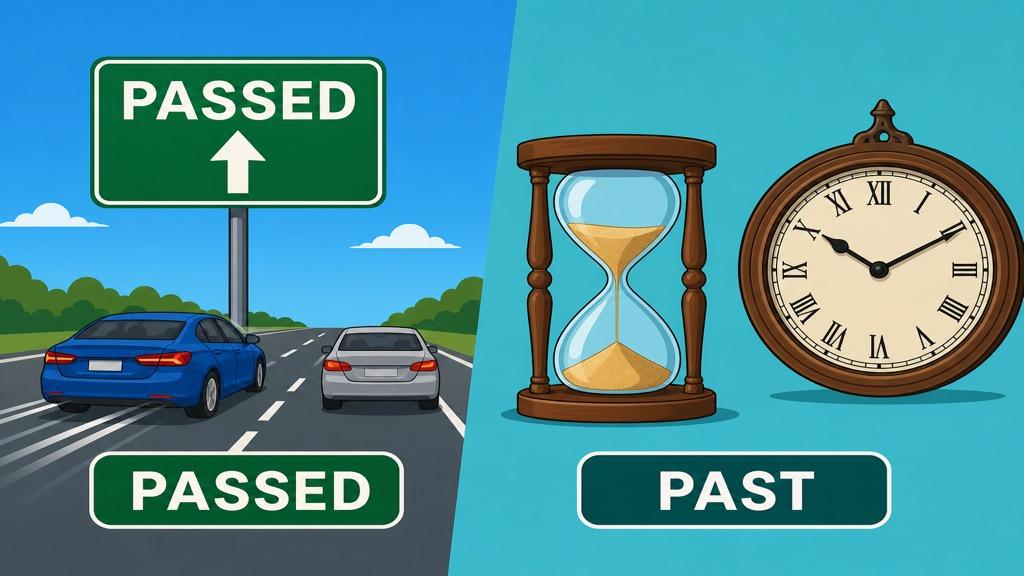
What Is the Difference Between Passed and Past?
"Passed" is the past tense of the verb "to pass." "Past" refers to an earlier time, or works as a noun, adjective, preposition, or adverb, but never as a verb. If you are describing an action that happened, you almost always want "passed."
- Passed: "She passed the exam." (Verb, an action.)
- Past: "That is all in the past." (Noun, an earlier time.)
The simple rule: if the word is doing the job of a verb, describing something that moved, went by, or succeeded, use "passed" with two s's. For everything else, use "past."
Why Do People Confuse Passed and Past?
The two words sound identical and both relate to movement and time, so the line between them blurs. The deeper cause is that "passed" is the only one that is a verb, while "past" covers four other parts of speech. Writers reach for the familiar "past" out of habit and end up writing "he past the ball," which should be "he passed the ball." The fix is to test whether the word is an action.
How Do You Use Passed Correctly?
"Passed" is the past tense and past participle of the verb "to pass." It always describes an action. That action can be physical movement, the going by of time, or success at something.
When Does Passed Describe Movement?
Use "passed" when someone or something moved by, ahead of, or through:
- "The car passed us on the highway."
- "He passed the salt across the table."
- "They passed through three towns before noon."
- "A shadow passed over the wall."
Can Passed Describe Time or Success?
Yes. "Passed" covers time elapsing and tests or milestones being cleared:
- "Two hours passed before she replied."
- "He passed his driving test."
- "The bill passed in the senate."
- "Sadly, our neighbor passed away last spring."
If the sentence describes an action that took place, "passed" is the word, with two s's every time.
How Do You Use Past Correctly?
"Past" works as a noun, an adjective, a preposition, and an adverb, but it is never a verb. This is the single most useful fact for telling the two apart.
When Is Past a Noun or Adjective?
As a noun, "past" names an earlier time. As an adjective, it describes something gone by:
- "We cannot change the past." (Noun.)
- "Over the past week, sales rose." (Adjective.)
- "Her past jobs were all in publishing." (Adjective.)
When Is Past a Preposition or Adverb?
As a preposition or adverb, "past" shows position or direction, meaning beyond or by:
- "Walk past the bakery and turn left." (Preposition.)
- "It is half past three." (Preposition.)
- "The runners ran past without stopping." (Adverb.)
Notice that even when "past" appears near movement, it is describing direction, not performing the action. The verb in "ran past" is "ran," not "past."
What Is the Easiest Way to Remember the Difference?
Test whether the word is a verb. If you can put "has," "have," or "had" in front of it, you need "passed": "she has passed," "they had passed." If that does not work, use "past." Because "past" is never a verb, this single check resolves nearly every case.
Is There a Quick Test for Walked Past vs Walked Passed?
Yes. The correct phrase is "walked past." Here "walked" is already the verb carrying the action, so the word after it shows direction and takes "past." Writing "walked passed" puts two verbs side by side, which does not work. Whenever another verb is already doing the work, the direction word is "past." This kind of structural check is exactly what a solid self-editing checklist helps you build into a habit.
How Do You Handle These Words in Formal Writing?
In essays, fiction, and professional documents, mixing these up is a common but noticeable slip. "The deadline past" should be "the deadline passed," and "in the passed" should be "in the past." Because the error sits at the level of grammar rather than spelling, it signals to an attentive reader that the draft was not closely revised. Our guide to how to improve your writing skills covers the proofreading habits that catch these before they reach a reader.
Can Grammar Tools Catch This Mistake?
A basic spell checker accepts both words, since each is correctly spelled, so it will not flag "he past the test." The mistake is grammatical and contextual. ShyEditor reads the role each word plays in the sentence and flags when "past" appears where a verb is needed, or when "passed" shows up where you mean an earlier time or a direction. If you are polishing a manuscript, pair it with our how to edit your own writing guide.
Quick Reference: Passed vs Past
| Word | Part of Speech | Meaning | Example |
|---|---|---|---|
| Passed | Verb | Past tense of "to pass," an action | "She passed the test." |
| Past | Noun / adjective / preposition / adverb | An earlier time, or beyond | "Walk past the door." |
Practice Sentences
Test yourself, which word is correct?
- "Several years _____ before they met again." - passed (verb, time elapsing)
- "Learn from the _____ and move on." - past (noun)
- "The cyclist _____ three cars at the light." - passed (verb, movement)
- "The store is just _____ the corner." - past (preposition, direction)
- "Over the _____ month, she finished her draft." - past (adjective)
Write With Confidence
Passed and past sound the same but play completely different grammatical roles, and the wrong one quietly breaks your sentence. ShyEditor catches these contextual slips before they reach the page, whether you are writing a novel, an essay, or an everyday email. Try it free: https://www.shyeditor.com