
- Published on
Through vs. Threw vs. Thorough: What Is the Difference?
- Authors

- Name
- Tony
- @shyeditor
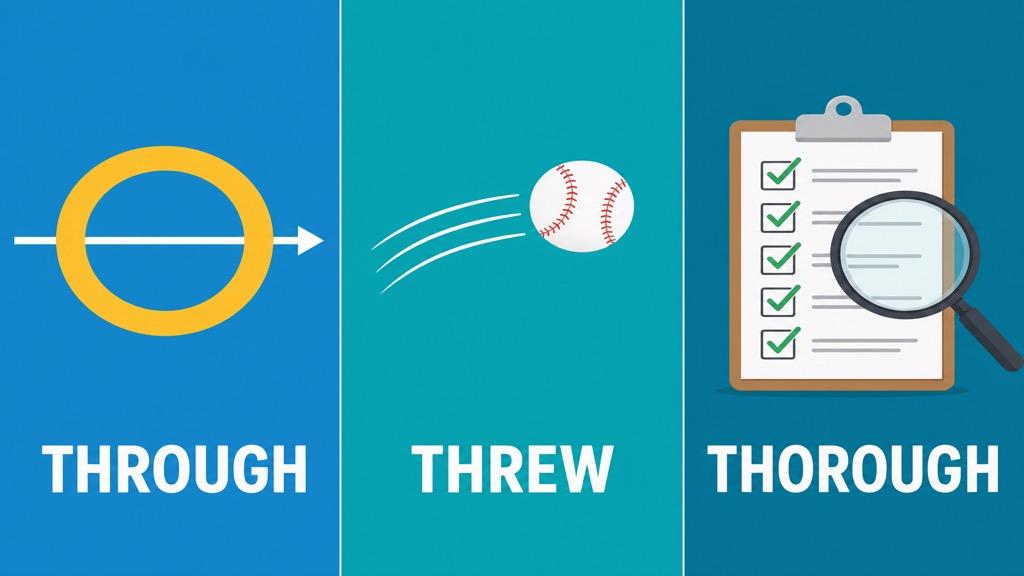
What Is the Difference Between Through, Threw, and Thorough?
"Through" means into one side and out the other. "Threw" is the past tense of the verb "to throw." "Thorough" means complete, careful, and detailed. The first two sound identical, while "thorough" has an extra syllable and a different meaning entirely.
- Through: "We drove through the tunnel." (In and out the other side.)
- Threw: "She threw the ball." (Past tense of throw.)
- Thorough: "He gave the report a thorough review." (Complete and detailed.)
The simple rule: if you mean tossing something, use "threw." If you mean passing from one side to another, use "through." If you mean careful and complete, use "thorough."
Why Do People Confuse Through, Threw, and Thorough?
"Through" and "threw" are perfect homophones, so the ear gives no help. "Thorough" is pronounced differently, with two syllables ("THUR-uh"), but its spelling sits just one letter away from "through," so the eye trips over it. Many writers type "thorough" when they mean "through," producing "we went thorough the door." The fix is to match each word to its distinct meaning.
How Do You Use Through Correctly?
"Through" works mainly as a preposition or adverb meaning from one side to the other, and it can also mean finished. It always involves passage, completion, or means.
When Does Through Mean Passage?
Use "through" for movement from one side to another, in space or time:
- "The train went through the mountains."
- "Sunlight streamed through the window."
- "She read through the entire manuscript."
- "We worked through the weekend."
Can Through Mean Finished or By Means Of?
Yes. "Through" also signals completion or a method:
- "Are you through with the laptop?" (Finished.)
- "We are through here." (Finished.)
- "He got the job through a friend." (By means of.)
In every sense, "through" carries the idea of going from start to end, or by some channel, never the action of tossing.
How Do You Use Threw Correctly?
"Threw" is the simple past tense of the verb "to throw." It always describes the completed action of propelling something. The present tense is "throw," and the past participle is "thrown."
When Does Threw Describe an Action?
Use "threw" for any past act of throwing, literal or figurative:
- "He threw the keys onto the table."
- "The storm threw branches across the road."
- "She threw a party for fifty guests."
- "The news threw them into a panic."
Notice the figurative uses: "threw a party," "threw him off," "threw caution to the wind." All still trace back to the verb "to throw." If "throw" or "thrown" fits the same slot in a different tense, you need "threw."
How Do You Use Thorough Correctly?
"Thorough" is an adjective meaning complete, careful, and attentive to detail. It describes the quality of work, a search, or a person's approach. It is not a homophone of the other two, just a frequent misspelling of "through."
When Does Thorough Mean Complete and Careful?
Use "thorough" when nothing is overlooked:
- "The detective made a thorough search of the room."
- "She is thorough in everything she does."
- "Give the draft a thorough edit before sending it."
- "We need a more thorough explanation."
The related adverb is "thoroughly": "thoroughly cleaned," "thoroughly confused." If you can replace the word with "complete" or "careful," you want "thorough," not "through." A thorough self-editing pass is exactly the habit that keeps these three apart in your own writing.
What Is the Easiest Way to Remember the Difference?
Match each word to a partner word. "Threw" relates to "throw," and both contain "row." "Thorough" relates to "complete," and the extra "o" in the middle reminds you it is the longer, fuller word, fitting its meaning. Whatever is left, the simple "through," is your everyday word for passing from one side to the other.
Is There a Quick Test for Went Through vs Went Thorough?
Yes. The correct phrase is "went through." "Thorough" is an adjective and cannot follow "went" the way a preposition can, so "went thorough the report" is always wrong. If a noun follows and you mean passing into and out of it, use "through." Reserve "thorough" for describing how complete something is: "a thorough report," not "went thorough." This kind of part-of-speech check is something a grammar checker can flag automatically.
How Do You Handle These Words in Formal Writing?
In essays, fiction, and professional documents, these mix-ups are common and easy for a careful reader to spot. "He through the ball" and "a through investigation" both signal a draft that skipped a final proofread. Because the words span different parts of speech, the wrong one can briefly derail the sentence. Our guide to how to improve your writing skills covers the habits that keep slips like these out of finished work.
Can Grammar Tools Catch This Mistake?
A basic spell checker accepts all three words, since each is spelled correctly, so it will not flag "she through the ball" or "went thorough the door." The errors are contextual. ShyEditor reads the role each word plays and flags when "through" appears where the verb "threw" belongs, or when "thorough" lands where you mean passage. If you are polishing a manuscript, pair it with our how to edit your own writing guide.
Quick Reference: Through vs Threw vs Thorough
| Word | Part of Speech | Meaning | Example |
|---|---|---|---|
| Through | Preposition / adverb | Into and out the other side; finished | "Walk through the gate." |
| Threw | Verb | Past tense of "to throw" | "He threw the ball." |
| Thorough | Adjective | Complete, careful, detailed | "A thorough review." |
Practice Sentences
Test yourself, which word is correct?
- "The pitcher _____ a fastball." - threw (past tense of throw)
- "We hiked _____ the forest." - through (passage)
- "Her notes were detailed and _____." - thorough (complete)
- "Are you _____ with the printer?" - through (finished)
- "She _____ her coat over the chair." - threw (past tense of throw)
Write With Confidence
Through, threw, and thorough sit just a letter or a sound apart, yet each does a different job, and the wrong one undermines an otherwise polished sentence. ShyEditor catches these contextual slips before they reach the page, whether you are writing a novel, an essay, or an everyday email. Try it free: https://www.shyeditor.com