
- Published on
Wear vs. Where vs. Ware: What Is the Difference?
- Authors

- Name
- Tony
- @shyeditor
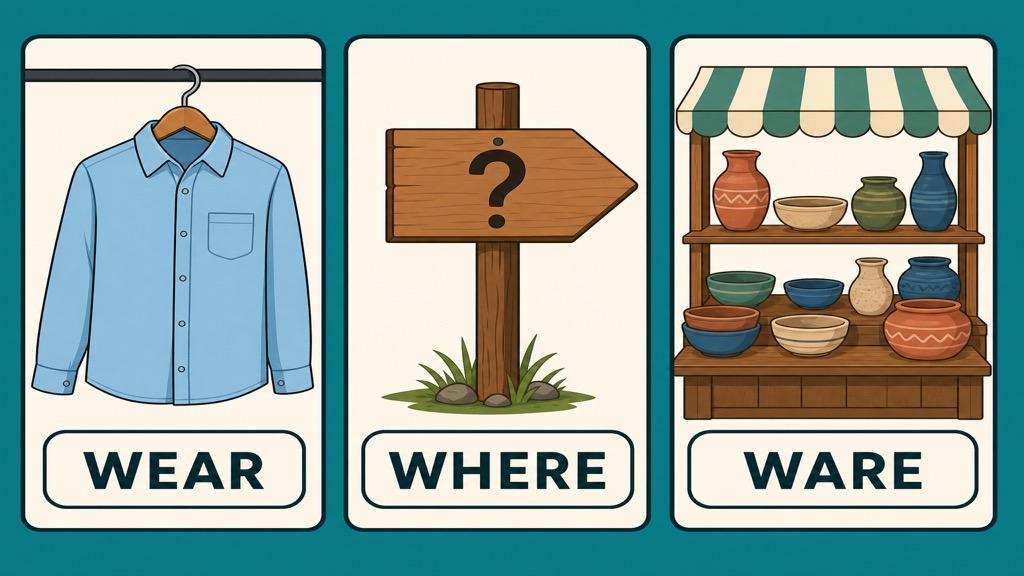
What Is the Difference Between Wear, Where, and Ware?
"Wear" means to have clothing or accessories on your body, or to erode through use. "Where" asks about or refers to a place. "Ware" means goods or products, usually offered for sale. All three sound the same, but each belongs to a different part of speech and a different meaning.
- Wear: "She decided to wear the blue dress." (Have on the body.)
- Where: "Where did you leave your keys?" (In what place.)
- Ware: "The potter sold his ware at the market." (Goods for sale.)
The simple rule: "wear" is for clothing, "where" is for places, and "ware" is for products, and it most often appears as the plural "wares."
Why Do People Confuse Wear, Where, and Ware?
All three are homophones, pronounced identically, and the first two ("wear" and "where") differ by just one letter. "Ware" is the least common as a standalone word, so it is rarely confused, but "wear" and "where" are swapped constantly, producing errors like "what should I where today" or "wear are you going." The fix is to anchor each spelling to its meaning with a quick cue.
How Do You Use Wear Correctly?
"Wear" is a verb meaning to have something on your body, and by extension to damage or reduce something through repeated use. As a noun it refers to clothing of a particular type.
When Does Wear Mean to Have On the Body?
Use "wear" when clothing, jewelry, or accessories are on a person:
- "He likes to wear a hat in winter."
- "You should wear sunscreen at the beach."
- "She always wears silver earrings."
- "What will you wear to the wedding?"
The past tense is "wore" and the past participle is "worn," as in "she wore a coat" and "she had worn it for years."
When Does Wear Mean to Erode or as a Noun?
"Wear" can also mean to deteriorate from use, and as a noun it names a category of clothing:
- "The stone steps had begun to wear smooth."
- "These tires show a lot of wear."
- "The shop sells men's and women's wear."
This is the sense behind compound words like "footwear," "swimwear," and "menswear," which all describe things you wear.
How Do You Use Where Correctly?
"Where" relates to place or position. It works as a question word, a conjunction, or a relative pronoun, and it always points to a location, literal or figurative. This is the most common of the three words by a wide margin.
When Should You Use Where in a Question?
Use "where" to ask about a place:
- "Where are you going?"
- "Where did I put my phone?"
- "Where does this road lead?"
When Is Where Used to Join Clauses?
"Where" also connects ideas by referring to a place or situation:
- "This is the town where I grew up."
- "Leave the keys where you found them."
- "She reached a point where she could not continue."
If your sentence is about location or position rather than clothing or goods, "where" is almost always the word you want.
How Do You Use Ware Correctly?
"Ware" means an article of merchandise or a manufactured product, most often used in the plural "wares." It is the least common of the three in everyday writing but survives in many familiar compound words.
When Does Ware Mean Goods for Sale?
Use "ware" or "wares" for products offered for sale:
- "The merchant displayed his wares on a blanket."
- "Street vendors hawked their wares to tourists."
- "She sold handmade ware at the craft fair."
Where Does Ware Appear in Compound Words?
"Ware" lives inside many common nouns that name categories of goods or material:
- "Software" and "hardware" for computing.
- "Silverware" and "glassware" for the dining table.
- "Earthenware" and "stoneware" for pottery.
Recognizing "ware" as the goods word makes these compounds easy to spell.
What Is the Easiest Way to Remember the Difference?
Match each spelling to its meaning. "Wear" contains "ear," and you can wear an earring on your ear. "Where" contains "here," and both are about place, since "here" and "where" are a natural pair. "Ware" is what is left for goods, and you can connect it to "warehouse," the building where products are stored.
Is There a Trick for Wear vs Where?
Yes. The reliable cue is "where" has "here" inside it, and questions about place often pair "where" with "here," as in "Where is it? It's here." "Wear" hides "ear," a body part, which reminds you it is the word for what goes on your body. Tying each spelling to a small word inside it makes the right choice automatic.
How Do You Handle These Words in Formal Writing?
In fiction especially, describing what characters wear and where they are sets the scene, so these words appear constantly. A line like "she didn't know wear to go" pulls an attentive reader straight out of the story. Precise, vivid clothing details are part of strong characterization, which our guide to character description examples explores in depth.
Can Grammar Tools Catch This Mistake?
A standard spell checker accepts all three spellings as valid words, so it will not flag "wear are you" when you meant "where." The error is contextual. ShyEditor reads the meaning of your sentence and flags when "wear" appears where you mean a place, or when "where" shows up where you mean clothing. If you are building a believable setting, pair this with our world-building checklist to keep both your details and your spelling consistent.
Quick Reference: Wear vs Where vs Ware
| Word | Meaning | Example |
|---|---|---|
| Wear (verb) | To have on the body | "Wear a coat." |
| Wear (noun) | A type of clothing | "Men's wear." |
| Where | In or to what place | "Where is it?" |
| Ware | Goods for sale | "Sold their wares." |
Practice Sentences
Test yourself, which word is correct?
- "_____ did you put the map?" - where (place)
- "It's too cold to _____ shorts today." - wear (have on the body)
- "The vendors spread their _____ across the table." - wares (goods)
- "This is the cafe _____ we first met." - where (place)
- "Constant use began to _____ down the carpet." - wear (erode)
Write With Confidence
Homophones like wear, where, and ware sound identical but carry completely different meanings. ShyEditor catches these contextual slips before they reach the page, whether you are writing a novel, a description, or product copy. Try it free: https://www.shyeditor.com