
- Published on
Right vs. Write vs. Rite: What Is the Difference?
- Authors

- Name
- Tony
- @shyeditor
What Is the Difference Between Right, Write, and Rite?
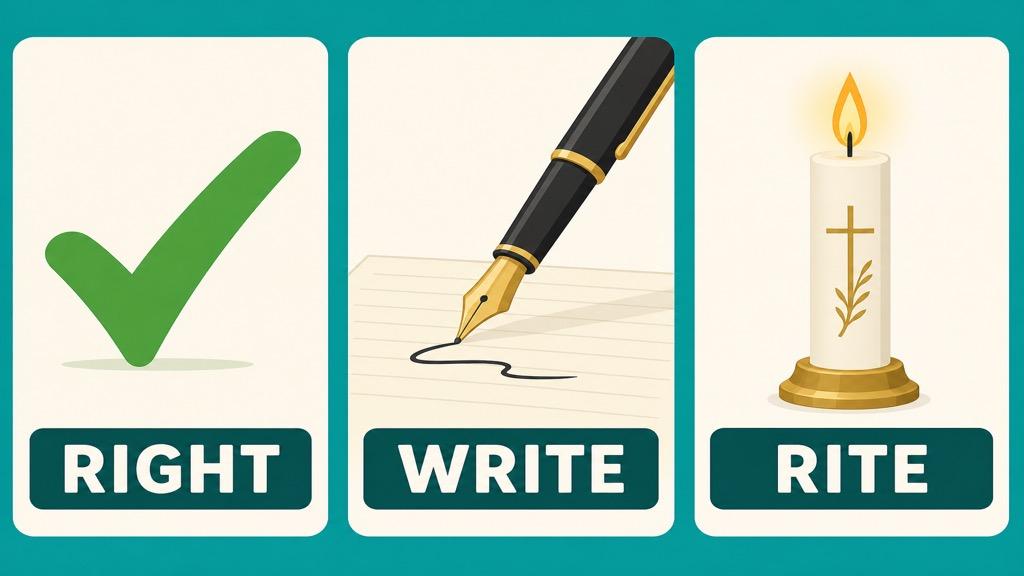
"Right" means correct, a direction, or an entitlement. "Write" means to form letters and words. "Rite" means a formal ceremony or ritual. All three are pronounced the same way, but each has its own distinct meaning and is rarely interchangeable.
- Right: "You gave the right answer." (Correct.)
- Write: "I need to write a letter." (Form words.)
- Rite: "The ceremony was an ancient rite." (A ritual.)
The simple rule: "write" with a "w" is the one about putting words on a page, "rite" is the short, formal word for a ceremony, and "right" covers everything else.
Why Do People Confuse Right, Write, and Rite?
All three are homophones, pronounced identically, and they cluster around writing and correctness, so the brain reaches for the most familiar one. "Right" is by far the most common, so it gets overused, producing errors like "a right of passage." "Rite" is unusual and easy to forget, which is exactly why phrases like "rite of passage" get misspelled. The fix is to learn which spelling matches which meaning.
How Do You Use Right Correctly?
"Right" is the most versatile of the three. It can mean correct, the opposite of left, a moral or legal entitlement, or it can act as an adverb meaning directly or immediately.
When Does Right Mean Correct or a Direction?
Use "right" for accuracy or for the direction opposite of left:
- "That is the right answer."
- "Turn right at the corner."
- "You were right about the weather."
- "Hold the pencil in your right hand."
When Does Right Mean an Entitlement?
"Right" also names something a person is morally or legally owed:
- "Everyone has the right to vote."
- "Freedom of speech is a basic right."
- "She knew her rights."
Note the correct phrase is "rite of passage," not "right of passage," because it refers to a ceremony marking a life transition, not an entitlement. This is one of the most common mix-ups in the group.
How Do You Use Write Correctly?
"Write" is a verb meaning to form letters, words, or text, or to compose something such as a story, letter, or piece of music. The silent "w" at the start is the clue that sets it apart from its homophones.
When Should You Use Write in a Sentence?
Use "write" whenever words or text are being produced:
- "She wants to write a novel."
- "Please write your name at the top."
- "He writes for a living."
- "Can you write down the address?"
The past tense is "wrote" and the past participle is "written," as in "she wrote a book" and "the book was written last year."
What About Wright, the Fourth Homophone?
There is a fourth word that sounds the same, "wright," meaning a maker or builder. It rarely stands alone but survives in job titles like "playwright" (a writer of plays), "shipwright," and "wheelwright." A common error is spelling it "playwrite," but a playwright crafts plays the way a wheelwright crafts wheels, so the "wright" spelling is correct.
How Do You Use Rite Correctly?
"Rite" is a noun meaning a formal religious or ceremonial act, or an established ritual. It is the shortest and least common of the three, but it is the right word in several fixed phrases.
When Does Rite Mean a Ceremony or Ritual?
Use "rite" for solemn or traditional ceremonies:
- "Baptism is a Christian rite."
- "The tribe performed an ancient rite."
- "Graduation felt like a rite of passage."
What Are the Most Common Rite Phrases?
A few set phrases reliably take "rite":
- "Rite of passage" for a milestone that marks a life transition.
- "Last rites" for the ceremony performed near death.
- "Funeral rites" for the rituals surrounding a burial.
If the meaning is ceremony or ritual, choose "rite," not "right" or "write."
What Is the Easiest Way to Remember the Difference?
Use a cue for each. "Write" begins with "w," like "words," which is what you write. "Rite" is short, like a "ritual," and both begin with "ri." "Right" is left over for correctness, direction, and entitlements, the everyday meanings you reach for most often.
Is There a Trick for Rite of Passage?
Yes. Picture "rite" as a tiny "ritual," since both words start with "ri" and refer to a ceremony. A rite of passage is a ceremonial milestone, not a road you have the right to use and not something you write down. When you catch yourself typing "right of passage," remember that a ceremony, not an entitlement, is involved.
How Do You Handle These Words in Formal Writing?
In essays, fiction, and professional writing, mixing these up signals carelessness. "He wanted to right a story" or "her right of passage into adulthood" tells an attentive reader that the wrong homophone slipped through. For writers, getting "write" right matters especially, and sharpening that skill is the focus of our guide to how to improve your writing skills.
Can Grammar Tools Catch This Mistake?
A standard spell checker accepts all three spellings as valid words, so it will not flag "right of passage" or "right a letter." The error is contextual. ShyEditor reads the meaning of your sentence and flags when "right" appears where you mean to compose text or describe a ceremony, or when "write" shows up where you mean correct. If you are revising a manuscript, our how to edit your own writing guide pairs well with a tool that catches what tired eyes miss.
Quick Reference: Right vs Write vs Rite
| Word | Meaning | Example |
|---|---|---|
| Right | Correct, a direction, or an entitlement | "The right answer." |
| Write | To form letters and words | "Write a story." |
| Rite | A ceremony or ritual | "A sacred rite." |
| Wright | A maker or builder | "A playwright." |
Practice Sentences
Test yourself, which word is correct?
- "Make sure you spell your name _____." - right (correct)
- "She stayed up late to _____ another chapter." - write (form words)
- "The coming-of-age ceremony was a _____ of passage." - rite (ritual)
- "Turn _____ at the second traffic light." - right (direction)
- "The priest performed the last _____." - rites (ceremony)
Write With Confidence
Homophones like right, write, and rite sound identical but carry completely different meanings. ShyEditor catches these contextual slips before they reach the page, whether you are writing a novel, an essay, or a heartfelt letter. Try it free: https://www.shyeditor.com