
- Published on
Affect vs. Effect: How to Use Each Correctly (With Examples)
- Authors

- Name
- Tony
- @shyeditor
What Is the Difference Between Affect and Effect?
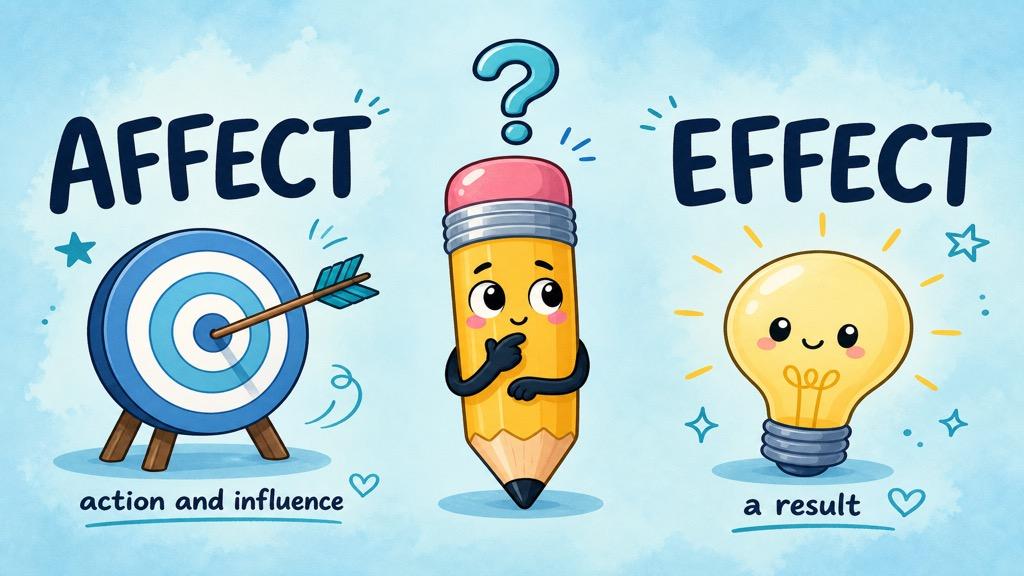
"Affect" is a verb meaning to influence something. "Effect" is a noun meaning the result of that influence. That core rule covers the vast majority of usage. Once you understand it and a handful of exceptions, you can stop second-guessing yourself for good.
How Do You Use Affect and Effect in a Sentence?
"Affect" describes an action:
- "The rain affected our travel plans."
- "Lack of sleep affects concentration."
"Effect" refers to the result or outcome of that action. It names a thing:
- "The rain had a noticeable effect on traffic."
- "The effects of sleep deprivation are well documented."
A quick way to remember: Affect = Action (verb), Effect = End result (noun).
Why Are Affect and Effect So Easy to Confuse?
Both words trace back to the Latin verb afficere, meaning "to do something to" or "to act on." They arrived in English through slightly different paths: "affect" through the Old French affecter, and "effect" through the Latin effectus. Their shared ancestry is exactly why they feel so interchangeable. Add in the fact that they sound nearly identical in fast speech, and it's no surprise that this is one of the most Googled grammar questions in English.
Can Effect Be a Verb and Affect Be a Noun?
The basic verb/noun rule covers about 95% of real-world usage. But English wouldn't be English without exceptions. Knowing these edge cases will help you handle the remaining 5% with confidence.
When Is Effect Used as a Verb?
"Effect" can be used as a verb meaning "to bring about" or "to cause." This usage is more formal and appears most often in business, legal, and political writing:
- "The new CEO effected sweeping changes across the organization."
- "The treaty was designed to effect lasting peace in the region."
Notice that "effect" as a verb doesn't mean to influence - it means to make something happen from scratch. If you can replace the word with "bring about" or "implement," then "effect" as a verb is correct.
When Is Affect Used as a Noun?
In psychology and psychiatry, "affect" is used as a noun (pronounced with the stress on the first syllable: AFF-ect) to describe an observable emotional state:
- "The patient displayed a flat affect during the evaluation."
- "Her cheerful affect put the whole room at ease."
Unless you're writing in a clinical context, you're unlikely to need this usage. But recognizing it helps you understand why you might occasionally see "affect" sitting where you'd expect a noun.
How Do You Know Which One to Use?
When choosing between these words, ask yourself:
- Am I describing an action (a verb)? Use "affect." The noise affected my focus.
- Am I describing a result (a noun)? Use "effect." The noise had a negative effect.
- Am I saying "to bring about" or "to implement"? Use "effect" as a verb. She effected a new policy.
- Am I describing an emotional state in a clinical sense? Use "affect" as a noun. The patient's affect was flat.
What Are the Most Common Affect vs Effect Mistakes?
Even with a clear rule, certain sentences trip people up more than others. Let's walk through the situations where writers most often stumble and look at practical ways to stay on track.
Is It "Affect Change" or "Effect Change"?
Some sentence structures make the choice harder because the word sits in an ambiguous position:
- "How does this affect/effect the outcome?" You need a verb here. The answer is "affect."
- "The policy had little affect/effect." You need a noun here. The answer is "effect."
- "We need to affect/effect change." This is the tricky one. If you mean "bring about change," use "effect." If you mean "influence change that's already happening," use "affect."
The phrase "effect change" is a common stumbling point because most people have internalized the "affect = verb" rule so deeply that "effect change" looks wrong. But it's correct, and it's a phrase you'll encounter frequently in professional writing.
What Are the Best Ways to Remember Affect vs Effect?
Beyond the Affect/Action and Effect/End result trick, here are a few more:
- The RAVEN method: Remember, Affect is a Verb, Effect is a Noun.
- Cause and effect: You already know this phrase. "Effect" is always the noun in it, so let that familiar pairing anchor your memory.
- "The arrow affected the aardvark": The verb (affect) has the same starting letter as the action words in the sentence.
Will Spell Check Catch Affect vs Effect Errors?
Standard spell checkers won't catch this error because both "affect" and "effect" are correctly spelled words. Your spell checker has no way of knowing which one you meant. Grammar-aware tools like Shy Editor analyze context rather than just spelling, which means they can flag when you've used "affect" where "effect" belongs, or vice versa. This is exactly the kind of subtle error that separates polished writing from writing that just passes a basic spell check.
Does Affect vs Effect Matter in Professional Writing?
Getting this distinction right matters more in some contexts than others. In a text message to a friend, nobody will notice. In a client proposal, a published article, or a legal document, the wrong choice can undermine your credibility.
Business Communication
In emails, reports, and presentations, "affect" and "effect" show up constantly:
- Correct: "The supply chain disruption affected Q3 revenue." (verb — it influenced revenue)
- Correct: "The effect on Q3 revenue was significant." (noun — the result on revenue)
- Correct: "Leadership must effect these changes before Q4." (verb — bring about the changes)
Using the wrong one in a board presentation or investor update signals carelessness. It's a small thing, but decision-makers notice small things.
Academic and Scientific Writing
Research papers frequently discuss causes and their effects, making this word pair unavoidable:
- "Caffeine affects short-term memory recall."
- "The effects of caffeine on memory have been widely studied."
- "Temperature changes affect enzyme activity."
- "The effect of temperature on enzyme activity is well documented."
In scientific contexts, precision isn't optional. Using "affect" when you mean "effect," or the reverse, can change the meaning of a sentence entirely.
Legal and Policy Writing
Legal documents often use "effect" as a verb in its formal sense:
- "This amendment shall effect the following changes to Section 4."
- "The ruling affects all pending cases."
Confusing these in a contract or regulation could create genuine ambiguity about whether something is being influenced or implemented - a distinction with real consequences.
How Do You Use Affect and Effect in Everyday Writing?
Outside of formal writing, the affect/effect distinction still matters, just in different ways. Online, where first impressions are formed quickly, clear writing builds trust.
Social Media and Content Creation
Blog posts, newsletters, and social media content reach audiences who judge your expertise partly by how well you write. A wellness influencer writing "meditation has a calming affect on the mind" loses a small measure of authority with readers who know the difference. The correct version, "meditation has a calming effect on the mind," costs nothing extra and preserves credibility.
For content creators, getting the basics right frees your audience to focus on your ideas rather than your grammar. You might also want to explore more tips on grammar and writing.
Email and Messaging
In professional emails, the words come up naturally:
- "This won't affect the timeline."
- "Let me know if there are any side effects."
- "Your feedback had a real effect on the final design."
Writing quickly in Slack or email is where mistakes happen most. Building the habit of pausing on "affect" vs "effect," even for a half-second, prevents errors that you can't take back once they're sent.
Which Common Phrases Use Affect and Which Use Effect?
Several fixed phrases use one or the other. Knowing these removes all guesswork:
- "In effect" - meaning "in practice" or "essentially." Always "effect."
- "Take effect" - meaning "become active." Always "effect."
- "To that effect" - meaning "with that meaning." Always "effect."
- "Personal effects" - meaning "belongings." Always "effect."
- "Cause and effect" - Always "effect."
- "Adversely affect" - meaning "negatively influence." Always "affect."
Quick Reference and Final Tips
Here's everything you need in one place, so you can come back to this section whenever you're unsure.
Side-by-Side Comparison
| Affect | Effect | |
|---|---|---|
| Usual role | Verb (to influence) | Noun (the result) |
| Example | The news affected her mood. | The news had a lasting effect. |
| Rare role | Noun (emotional display, psychology) | Verb (to bring about, formal) |
| Rare example | The patient showed flat affect. | The policy effected real reform. |
Five-Second Test
Still unsure which word to use? Try these substitutions:
- Replace the word with "influenced." If the sentence still works, use affect.
- Replace the word with "result." If the sentence still works, use effect.
- Replace the word with "brought about." If the sentence still works, use effect (as a verb).
Practice Sentences
Test yourself - which is correct?
- "The drought _____ crop yields across the region." → affected (verb: influenced)
- "One _____ of remote work is reduced commuting." → effect (noun: result)
- "The new manager _____ a complete turnaround." → effected (verb: brought about)
- "How will this _____ our deadline?" → affect (verb: influence)
- "The _____ of the medication wore off." → effects (noun: results)
Polish Your Writing With Shy Editor
Affect vs effect is just one of many subtle word-choice errors that slip past basic spell checkers. Shy Editor catches context-dependent mistakes like these, helping you write with confidence whether you're drafting a quick email or a polished article. Try it free and see the difference clear, accurate writing makes: https://www.shyeditor.com