
- Published on
Then vs. Than: How to Choose the Right Word Every Time
- Authors

- Name
- Tony
- @shyeditor
What Is the Difference Between Then and Than?
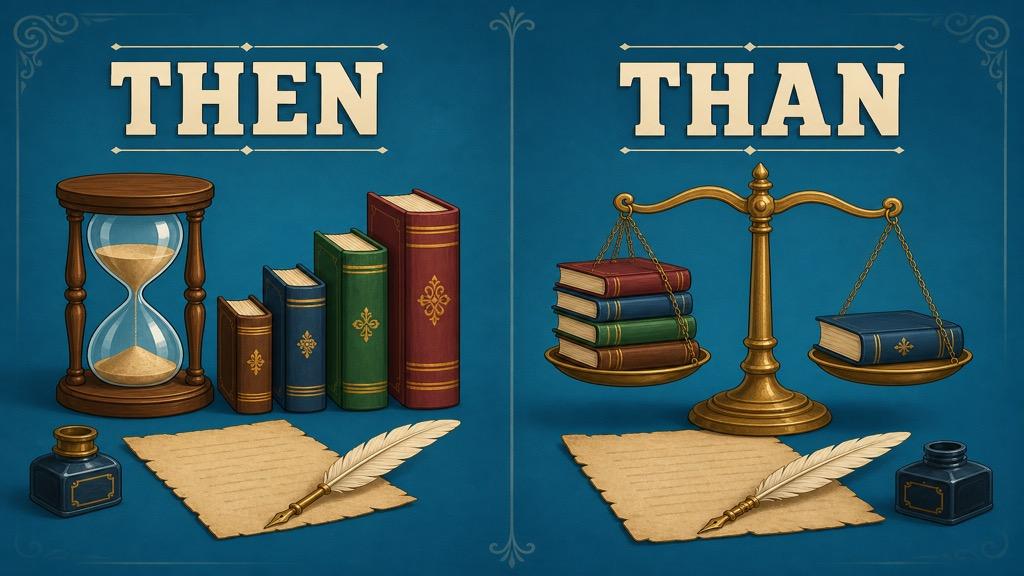
"Then" relates to time or sequence. "Than" is used for comparisons. If you're talking about what happens next or when something happened, use "then." If you're comparing two things, use "than." That single distinction covers virtually every case.
- Then = next, afterward, at that time. "We ate dinner, then watched a movie."
- Than = compared to. "This movie is better than the last one."
Why Do People Confuse Then and Than?
In casual spoken English, "then" and "than" sound nearly identical. Many speakers pronounce both as a quick, unstressed "th'n," making them indistinguishable in conversation. The confusion carries over into writing because you're transcribing a sound, not a meaning. Add in the fact that both words are short, common, and appear in similar sentence positions, and the mix-up becomes almost inevitable without a conscious check.
How Do You Use "Then" Correctly?
"Then" has several related meanings, all connected to time, sequence, or logical consequence. If the sentence involves when something happens, what comes next, or what follows from a condition, "then" is the word you need.
When Should You Use "Then" in a Sentence?
To indicate time or sequence:
- "Finish your homework, then you can play."
- "We drove to the airport, then realized we'd forgotten the tickets."
- "First add the flour, then stir in the eggs."
To mean "at that time":
- "I was living in Chicago back then."
- "Gas was cheaper then than it is now."
- "She wasn't ready then, but she is now."
To indicate a logical consequence (if... then):
- "If the forecast calls for rain, then bring an umbrella."
- "If you're not happy with the service, then cancel the subscription."
What Are Common Mistakes With "Then"?
The most frequent error is writing "than" when sequence or time is intended:
- Wrong: "We went to the store and than came home."
- Right: "We went to the store and then came home."
Ask yourself: am I comparing two things? If not, you almost certainly need "then."
How Do You Use "Than" Correctly?
"Than" introduces the second element in a comparison. Whenever you're saying something is more, less, better, worse, bigger, smaller, or different compared to something else, "than" is the word that connects them.
What Are Examples of "Than" in a Sentence?
- "She's taller than her brother."
- "This version is more reliable than the previous one."
- "I'd rather walk than drive in this traffic."
- "There were fewer people than we expected."
- "Nothing matters more than your health."
How Do You Know When a Sentence Needs "Than"?
Look for comparison words nearby. If the sentence contains any of these, "than" is almost always the correct choice:
- More/less than
- Better/worse than
- Bigger/smaller than
- Rather than
- Other than
- Taller/shorter/faster/slower than
- Any comparative adjective (-er form) + than
If you spot a comparative word in the sentence, reach for "than."
What Is the Fastest Way to Tell Then and Than Apart?
Two checks:
- Is the sentence making a comparison? Use than. "Coffee is better than tea."
- Is it about time, sequence, or consequence? Use then. "I'll finish this, then call you."
What Memory Tricks Help With Then vs Than?
- Th-E-n = tim-E / s-E-quence. The "e" in "then" matches the "e" in "time" and "next."
- Th-A-n = comp-A-rison. The "a" in "than" matches the "a" in "comparison."
- "And then" works, "and than" never does. If you can put "and" before the word, it's "then."
Does Getting Then vs Than Wrong Actually Matter?
This is one of those errors that's invisible in speech but obvious in writing. For casual messages, most readers will skip right past it. In professional contexts, it registers.
How Does This Mistake Look in Professional Writing?
Consider these real scenarios:
- Resume: "Managed a team of 12 and exceeded targets by more then 30%." The hiring manager reads a quantified achievement and a basic grammar error in the same line.
- Client report: "Revenue grew faster then projected in Q3." The numbers might be impressive, but the error undermines the polish.
- Marketing copy: "Better then the competition." A tagline built on comparison that uses the wrong comparison word.
These errors are especially noticeable when they appear alongside the very comparison or sequence the sentence is trying to communicate.
Can Grammar Tools Catch This Mistake?
Basic spell checkers won't flag it because both "then" and "than" are correctly spelled words. The error is contextual. You need a tool that understands whether you're comparing or sequencing. Shy Editor catches these context-dependent mix-ups automatically, analyzing sentence meaning rather than just checking spelling.
If you frequently trip over similar word pairs, our guide on affect vs effect covers another pair where the words sound alike but serve completely different purposes.
How Do You Handle Tricky Sentences With Then and Than?
Most then/than choices are straightforward, but a few sentence patterns cause more hesitation than others.
What About "Rather Than" vs "Rather Then"?
"Rather than" is always correct. This is a fixed comparison phrase:
- "I'd rather read than watch TV."
- "She chose to resign rather than accept the demotion."
- "Rather than argue, he walked away."
"Rather then" is never correct in standard English. If you see "rather" in the sentence, the next word is always "than."
What About "More Than" vs "More Then"?
Same rule. "More than" is always the correct form when comparing quantities:
- "The project cost more than $50,000."
- "More than 200 people attended."
- "She's been here more than ten years."
"More then" would only be correct if "then" is being used for time in a separate clause: "She wanted more; then she realized she had enough." But in that case, the two words aren't adjacent in the same way.
What About "No Sooner... Than"?
The phrase "no sooner... than" is a comparison of timing and always uses "than":
- "No sooner had we arrived than it started raining."
- "No sooner did she finish than the phone rang."
This one catches people because it feels like a time expression (and it is), but the structure is comparative: one event is being measured against another.
How Do You Use Then and Than in Formal Writing?
The rules don't change in formal writing, but precision matters more. Academic and business writing demand the correct word every time.
What About Academic and Business Contexts?
In academic writing:
- "The experimental group performed better than the control group."
- "Data was collected first from surveys, then from interviews."
- "If the p-value is less than 0.05, then the result is statistically significant."
That last example uses both words in a single sentence, which is a helpful illustration: "less than" is a comparison, "then" introduces the consequence.
In business contexts:
- "This quarter's revenue is higher than last quarter's."
- "Complete the audit, then submit your findings."
- "We'd rather invest in training than outsource."
Quick Reference: Then vs Than
| Word | Meaning | Test | Example |
|---|---|---|---|
| Then | Time, sequence, consequence | Replace with "next" or "at that time" | Do this, then that. |
| Than | Comparison | Look for a comparative word | Faster than expected. |
Practice Sentences
Test yourself - which is correct?
- "She finished the race faster _____ anyone expected." - than (comparison)
- "Add the sugar, _____ mix until smooth." - then (sequence)
- "I'd rather stay home _____ go out tonight." - than (comparison with "rather")
- "Back _____, we didn't have smartphones." - then (at that time)
- "The sequel was worse _____ the original." - than (comparison)
- "If it rains, _____ we'll move the party inside." - then (consequence)
Write With Confidence
Then vs than is a small error that shows up in big moments. Shy Editor catches contextual word-choice mistakes like these automatically, so you can focus on your ideas instead of second-guessing your grammar. Try it free: https://www.shyeditor.com