
- Published on
Their vs. There vs. They're: Which One Should You Use?
- Authors

- Name
- Tony
- @shyeditor
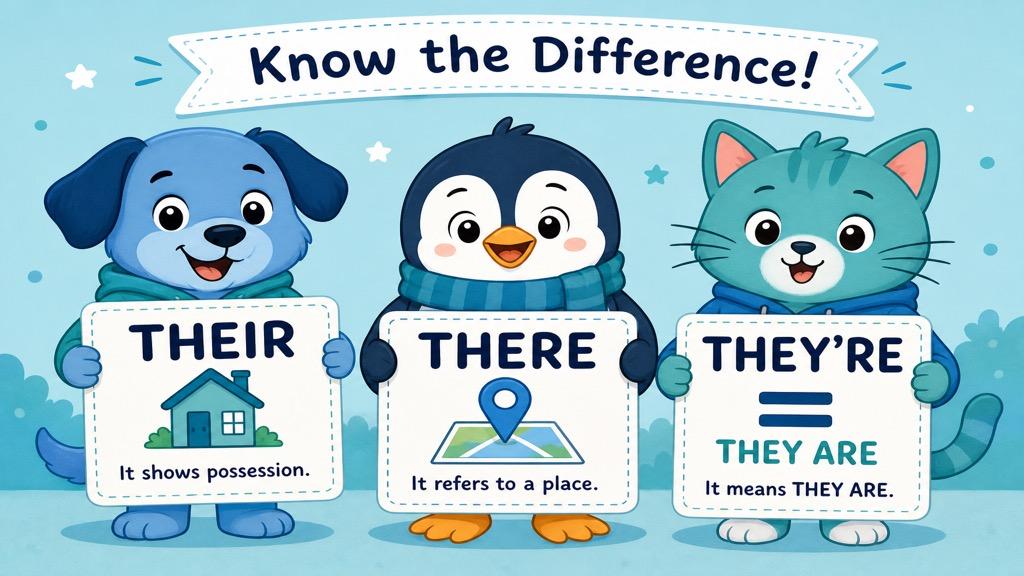
What Is the Difference Between Their, There, and They're?
"Their" shows possession, "there" refers to a place or existence, and "they're" is a contraction of "they are." All three sound identical when spoken, which is why they're among the most commonly confused words in English. But in writing, using the wrong one is immediately noticeable.
- Their = belonging to them. "The students forgot their books."
- There = a place or used to introduce something. "The books are over there." / "There are three left."
- They're = they are. "They're coming to the meeting."
Why Do People Mix Up Their, There, and They're?
These three words are homophones - they sound exactly the same but have completely different meanings and spellings. Your brain processes spoken language and written language differently. When you're writing quickly, your mind reaches for the sound of the word rather than its meaning, and since all three sound like "thair," it's easy to grab the wrong one. Even experienced writers make this mistake in first drafts, especially in fast-paced environments like email or messaging.
How Do You Use "Their" Correctly?
"Their" is a possessive pronoun. It shows that something belongs to a group of people. If you can replace the word with "his," "her," or "our" and the sentence still makes sense, then "their" is the right choice.
When Should You Use "Their" in a Sentence?
Use "their" any time you're describing something that belongs to or is associated with a group:
- "The team submitted their report on time."
- "Each employee should update their contact information."
- "The neighbors painted their fence last weekend."
- "Everyone has their own opinion on this."
Notice that "their" also works as a singular pronoun when referring to a person of unspecified gender. "Each employee should update their contact information" is widely accepted in modern English, and most style guides now endorse this usage.
What Are Common Mistakes With "Their"?
The most frequent error is using "there" or "they're" when ownership is intended:
- Wrong: "The company announced there new policy."
- Right: "The company announced their new policy."
The quick test: replace it with "our." If "The company announced our new policy" makes grammatical sense, you need "their."
How Do You Use "There" Correctly?
"There" has two main jobs: it points to a location, and it introduces the existence of something. If you can replace the word with "here" and the sentence still makes sense structurally, you likely need "there."
When Does "There" Refer to a Place?
Use "there" when pointing to a specific location, whether physical or abstract:
- "Put the box over there."
- "I've never been there before."
- "We're almost there."
- "She was there when it happened."
When Is "There" Used to Introduce a Sentence?
"There" also serves as what grammarians call an expletive - a placeholder that introduces the existence of something:
- "There are five people waiting outside."
- "There is no reason to worry."
- "There seems to be a problem with the order."
- "Is there anything else you need?"
In these sentences, "there" doesn't point to a place. It's a structural word that lets you introduce a subject after the verb.
How Do You Use "They're" Correctly?
"They're" always means "they are." No exceptions. If you can expand the word to "they are" and the sentence still works, "they're" is correct. If it doesn't work, you need one of the other two.
What Are Examples of "They're" in a Sentence?
- "They're arriving at noon." (They are arriving at noon.)
- "They're the best team in the league." (They are the best team.)
- "I think they're going to love it." (I think they are going to love it.)
- "They're not sure what happened." (They are not sure what happened.)
Why Is the Apostrophe Test So Reliable?
The apostrophe in "they're" exists because letters have been removed - the "a" in "are" gets dropped and replaced with an apostrophe. This means "they're" can always, without exception, be expanded back to "they are." No other version of the word works this way. This makes it the easiest of the three to verify. When in doubt, just try expanding it. If "they are" sounds wrong in the sentence, you don't want "they're."
What Is the Fastest Way to Tell Them Apart?
Run through these three checks in order. Each one takes about two seconds:
- Can you expand it to "they are"? Use they're. "They're ready" = "They are ready."
- Does it show ownership? Use their. "Their car" = the car belonging to them.
- Is it about a place, or does it introduce something? Use there. "Over there" / "There are many options."
What Memory Tricks Help With Their vs There vs They're?
- "Their" contains "heir" - an heir inherits things, which is about possession. "Their" is the possessive one.
- "There" contains "here" - both point to a place. "Here and there."
- "They're" contains an apostrophe - apostrophes in contractions always mean missing letters. Expand it to check.
Does Getting Their vs There vs They're Wrong Actually Matter?
In casual texting, most people won't call you out. But in any context where your writing represents you professionally, yes, it matters.
How Does This Mistake Look in Professional Writing?
Consider these real scenarios:
- Job application: "I believe there qualifications match your requirements." An employer reading this will question your attention to detail before they finish the sentence.
- Client email: "Their going to receive the deliverables by Friday." This is a small error, but it chips away at the confidence your client has in your thoroughness.
- Marketing copy: "There committed to quality." If you're selling credibility, this kind of mistake directly undermines the message.
These errors are especially damaging because they're so well-known. Unlike an obscure grammar rule, almost everyone learned the their/there/they're distinction in school, so getting it wrong stands out.
Can Grammar Tools Catch This Mistake?
Basic spell checkers won't flag it because all three words are spelled correctly. The error is contextual, not typographical. You need a tool that understands sentence meaning, not just spelling. Shy Editor analyzes context to catch exactly these kinds of homophone mix-ups before they reach your reader.
If you frequently confuse similar word pairs, you might also find our guide on affect vs effect helpful - it's another commonly mixed-up pair where spell check won't save you.
How Do You Use Their, There, and They're in Formal Writing?
The rules don't change in formal writing, but the stakes are higher. Academic papers, legal documents, and published articles are judged more harshly for basic errors.
What About Academic and Business Writing?
In academic writing, these words appear constantly:
- "The researchers presented their findings at the conference."
- "There is limited evidence to support this hypothesis."
- "They're among the most cited authors in the field."
In business contexts:
- "The stakeholders want their concerns addressed before the launch."
- "There are three options on the table."
- "They're expecting a revised proposal by end of week."
Is "Their" Acceptable as a Singular Pronoun?
Yes. Using "their" as a gender-neutral singular pronoun is now standard in most style guides, including the AP Stylebook and the Chicago Manual of Style:
- "Every customer deserves to have their issue resolved promptly."
- "Someone left their umbrella in the lobby."
This usage has centuries of precedent in English (Shakespeare used it), and it's the most natural way to refer to a person when their gender is unknown or irrelevant.
Quick Reference: Their vs There vs They're
| Word | Meaning | Test | Example |
|---|---|---|---|
| Their | Belonging to them | Replace with "our" | Their house is blue. |
| There | A place / introduces existence | Replace with "here" | The keys are over there. |
| They're | They are | Expand to "they are" | They're running late. |
Practice Sentences
Test yourself - which is correct?
- "_____ planning a surprise party for her." → They're (they are planning)
- "The dogs are in _____ crate." → their (the crate belonging to them)
- "Is _____ a pharmacy nearby?" → there (introduces existence)
- "_____ the ones who volunteered." → They're (they are the ones)
- "I left my jacket over _____." → there (a place)
- "_____ opinions differ on this topic." → Their (opinions belonging to them)
Write With Confidence
Their, there, and they're are among the most Googled grammar questions for a reason - even confident writers second-guess themselves. Shy Editor catches these contextual errors automatically, so you can write faster without worrying about homophone mix-ups. Try it free: https://www.shyeditor.com