
- Published on
Brake vs. Break: What Is the Difference?
- Authors

- Name
- Tony
- @shyeditor
What Is the Difference Between Brake and Break?
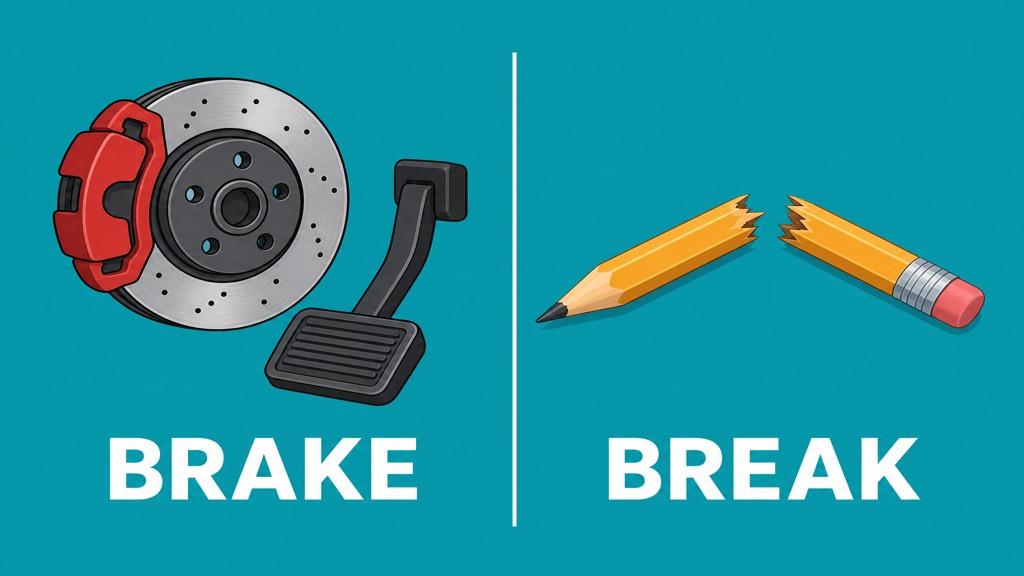
"Brake" is the device that slows or stops a vehicle, or the act of using it. "Break" means to separate something into pieces, to damage it, or to pause from an activity. The two words sound exactly the same but share no meanings.
- Brake: "She slammed on the brake to avoid the dog." (Device that stops a vehicle.)
- Break (verb): "Don't break the vase." (Separate or damage.)
- Break (noun): "Let's take a break." (A pause or rest.)
The simple rule: "brake" with an "a" is only about slowing or stopping a vehicle, and "break" with an "ea" covers everything else.
Why Do People Confuse Brake and Break?
The words are perfect homophones, pronounced identically, and they look similar, differing only in the middle vowels. Because "break" is far more common and covers many meanings, writers often default to it out of habit, producing errors like "hit the breaks" or "the breaks failed." The fix is a quick memory cue that ties "brake" to vehicles and "break" to everything else.
How Do You Use Brake Correctly?
"Brake" relates only to slowing or stopping. As a noun it is the mechanical device on a car, bike, or train, and as a verb it means to use that device to slow down.
When Should You Use Brake as a Noun?
Use "brake" for the part that stops a vehicle:
- "The brake pads need replacing."
- "He pumped the brake on the icy road."
- "Her bike's rear brake stopped working."
- "Put the parking brake on before you get out."
Note that the device is often referred to in the plural, "the brakes," so "hit the brakes" and "the brakes failed" both use "brake," not "break."
When Is Brake Used as a Verb?
"Brake" as a verb means to slow or stop by applying a brake:
- "Brake gently as you approach the turn."
- "The driver braked hard when the light changed."
- "Cars braked suddenly in the fog."
There is also a figurative phrase, "put the brakes on," meaning to slow or halt something, as in "the new rules put the brakes on spending." It still uses "brake," because the image is of a vehicle stopping.
How Do You Use Break Correctly?
"Break" works as a verb meaning to separate into pieces, to damage, or to interrupt, and as a noun meaning a pause, a gap, or a lucky opportunity. It is one of the most flexible words in English, with dozens of related senses.
When Does Break Mean to Damage or Separate?
Use "break" (verb) when something is split, shattered, or stopped from working:
- "Be careful not to break the glass."
- "He broke his arm skiing."
- "The old printer finally broke."
- "Waves break against the rocks."
When Does Break Mean a Pause or Rest?
Use "break" (noun) for an interruption, rest, or gap:
- "We took a coffee break."
- "There was a long break between scenes."
- "Students get a spring break in March."
Does Break Have Other Common Meanings?
Yes. "Break" appears in many idioms and extended senses: a "lucky break" is a fortunate opportunity, "daybreak" is when light first appears, "break the news" means to share information, and "break a habit" means to stop a behavior. All of them trace back to the core idea of something splitting, stopping, or starting suddenly.
What Is the Easiest Way to Remember the Difference?
Tie "brake" to vehicles: "brake" and "car" both relate to the road, and a brake makes a car stop. For everything else, use "break." If a vehicle is not slowing down, the word you want is almost always "break" with an "ea."
Is There a Trick Based on the Spelling?
Yes. "Brake" contains the letter "a," and so does "car," so the "a" word is the one that stops a car. "Break" contains "ea," the same letters that begin "easy," and you take it easy when you take a break. Linking each spelling to a vivid image makes the right one easier to recall.
How Do You Handle These Words in Formal Writing?
In fiction, journalism, and technical writing, swapping these words is an obvious error that distracts readers. A tense chase scene loses its grip when a character "slams on the breaks," and a safety notice that warns about faulty "breaks" undercuts its own authority. Precise word choice matters most in high-stakes moments, which is exactly where our guide to how to write action scenes can help you keep the tension intact.
Can Grammar Tools Catch This Mistake?
A standard spell checker accepts both spellings as valid words, so it will not flag "hit the breaks" when you meant "brake." The error is contextual. ShyEditor reads the meaning of your sentence and flags when "break" appears where you describe slowing a vehicle, or when "brake" shows up where you clearly mean to damage, separate, or pause. If you are polishing your own draft, our how to edit your own writing guide pairs well with a tool that catches what tired eyes miss.
Quick Reference: Brake vs Break
| Word | Meaning | Example |
|---|---|---|
| Brake (noun) | Device that stops a vehicle | "Hit the brake." |
| Brake (verb) | To slow or stop a vehicle | "Brake for the turn." |
| Break (verb) | To damage or separate | "Don't break it." |
| Break (noun) | A pause or rest | "Take a break." |
Practice Sentences
Test yourself, which word is correct?
- "The mechanic said the rear _____ was worn out." - brake (device)
- "Try not to _____ the antique mirror." - break (damage)
- "After two hours of writing, she needed a _____." - break (rest)
- "He had to _____ hard to avoid the cyclist." - brake (slow down)
- "A lucky _____ landed her the lead role." - break (opportunity)
Write With Confidence
Homophones like brake and break sound identical but mean completely different things. ShyEditor catches these contextual slips before they reach the page, whether you are writing a novel, a news article, or a safety manual. Try it free: https://www.shyeditor.com