
- Published on
Sight vs. Site vs. Cite: What Is the Difference?
- Authors

- Name
- Tony
- @shyeditor
What Is the Difference Between Sight, Site, and Cite?
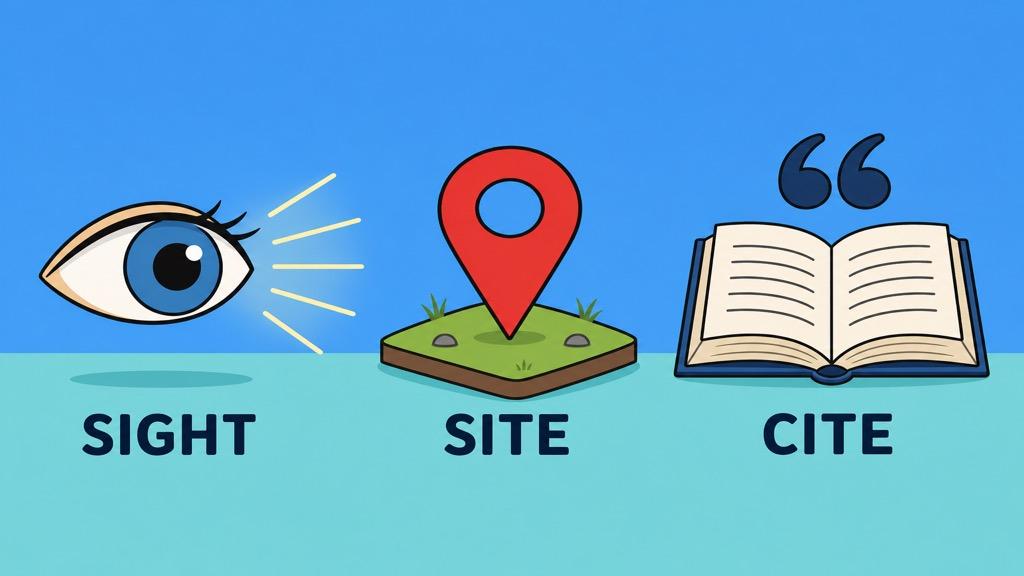
"Sight" means the ability to see or something that is seen. "Site" means a location or place. "Cite" means to quote or refer to a source. All three sound identical, but each belongs to a different part of speech and a different meaning.
- Sight: "The sunrise was a beautiful sight." (Something seen.)
- Site: "They chose a site for the new building." (A location.)
- Cite: "Remember to cite your sources." (Quote a source.)
The simple rule: "sight" relates to vision, "site" is a spot of ground or a place, and "cite" is the verb you use when crediting a source.
Why Do People Confuse Sight, Site, and Cite?
All three are homophones, pronounced exactly the same, so the ear gives no hint about spelling. "Site" and "cite" cause the most trouble in academic writing, where a phrase like "be sure to site your references" slips past easily. "Sight" gets pulled in because it is the most familiar of the three. The fix is to match each spelling to its meaning and its grammatical role, since "cite" is almost always a verb while "sight" and "site" are usually nouns.
How Do You Use Sight Correctly?
"Sight" is a noun meaning the ability to see, or the thing that is seen. It can also appear in verb form, meaning to spot or observe something.
When Does Sight Mean Vision or a View?
Use "sight" for anything connected to seeing:
- "She lost her sight in one eye."
- "The canyon was an incredible sight."
- "The ship vanished from sight."
- "Love at first sight."
When Is Sight Used as a Verb?
"Sight" can also mean to catch sight of something:
- "The sailors sighted land at dawn."
- "Birdwatchers sighted a rare eagle."
It also appears in fixed phrases like "out of sight," "sight unseen," and "set your sights on," all tied to the idea of seeing or looking.
How Do You Use Site Correctly?
"Site" is a noun meaning a particular place or location, such as a building site, an archaeological site, or a website. It can also be a verb meaning to place or position something.
When Does Site Mean a Location?
Use "site" for a physical or digital place:
- "The construction site was fenced off."
- "Archaeologists excavated the ancient site."
- "Bookmark our site for updates."
- "This is the site of the old factory."
When Is Site Used as a Verb?
Less commonly, "site" means to locate or position:
- "The town was sited near the river."
- "They sited the turbines on the ridge."
If you mean a spot, a plot of ground, or a web address, "site" is the word, never "sight" or "cite."
How Do You Use Cite Correctly?
"Cite" is a verb meaning to quote or refer to a source as evidence or authority, or to mention something as an example. It is the only one of the three that is primarily a verb.
When Does Cite Mean to Quote a Source?
Use "cite" when crediting where information came from:
- "Cite at least three peer-reviewed articles."
- "The lawyer cited a previous ruling."
- "He cited the study to support his claim."
This is the meaning that matters most in academic work. When you build a reference list in APA paper format or MLA paper format, you are citing sources, so the verb is always "cite."
Can Cite Mean to Mention or Commend?
Yes. "Cite" also means to name as an example or to formally acknowledge:
- "She cited budget cuts as the reason."
- "The officer was cited for bravery."
- "He was cited for a traffic violation."
The thread running through all uses is referring to something formally, whether a source, a reason, or a person.
What Is the Easiest Way to Remember the Difference?
Decide by meaning, not by spelling. If the word is about seeing or something seen, it is "sight." If it names a place, whether a plot of ground or a website, it is "site." If you are quoting or crediting a source, it is "cite."
Is There a Quick Test for Site vs Cite in Academic Writing?
Yes. When you are writing a research paper, ask whether you mean a place or an act of quoting. If you can replace the word with "quote" or "reference," use "cite" with a "c." If you mean a website or a physical location, use "site." You will never "site your sources," because sources are quoted, not located. A solid proofreading checklist catches this slip before submission.
How Do You Handle These Words in Formal Writing?
In essays, dissertations, and professional reports, confusing these three signals carelessness, and in academic work the "site" for "cite" error is especially common. Writing "the author sites several studies" tells a reader the wrong homophone slipped through. Because citations are central to credible research, getting "cite" right is part of building authority on the page, a skill our guide to how to improve your writing skills explores in depth.
Can Grammar Tools Catch This Mistake?
A standard spell checker accepts all three spellings as valid words, so it will not flag "site your sources" or "the construction sight." The error is contextual. ShyEditor reads the meaning of your sentence and flags when "site" appears where you mean to quote a source, or when "sight" shows up where you mean a location. If you are polishing a research paper or a novel, our how to edit your own writing guide pairs well with a tool that catches what tired eyes miss.
Quick Reference: Sight vs Site vs Cite
| Word | Part of Speech | Meaning | Example |
|---|---|---|---|
| Sight | Noun (also verb) | The ability to see, or something seen | "A welcome sight." |
| Site | Noun (also verb) | A location or place | "A building site." |
| Cite | Verb | To quote or refer to a source | "Cite your sources." |
Practice Sentences
Test yourself, which word is correct?
- "Please _____ the original study in your bibliography." - cite (quote a source)
- "The mountain view was a stunning _____." - sight (something seen)
- "They broke ground at the new _____ yesterday." - site (location)
- "The judge will _____ relevant case law." - cite (refer to)
- "The lighthouse was the first thing in _____." - sight (vision)
Write With Confidence
Homophones like sight, site, and cite sound identical but carry completely different meanings, and the wrong one can undercut an otherwise polished paper. ShyEditor catches these contextual slips before they reach the page, whether you are writing a novel, an essay, or a research paper. Try it free: https://www.shyeditor.com