
- Published on
Discrete vs. Discreet: What Is the Difference?
- Authors

- Name
- Tony
- @shyeditor
What Is the Difference Between Discrete and Discreet?
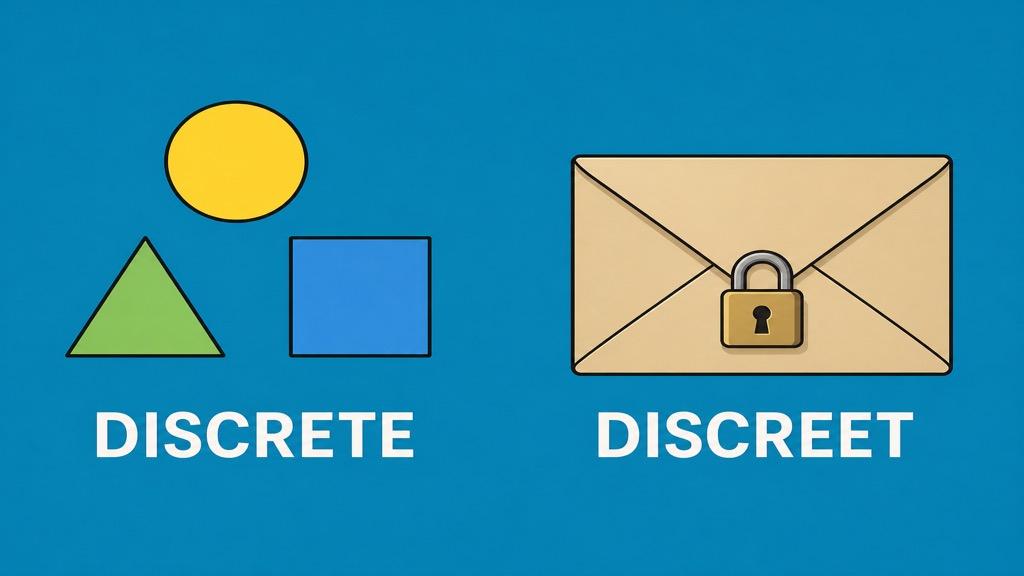
"Discrete" means separate, individually distinct, or not connected. "Discreet" means careful, tactful, or unobtrusive in a way that avoids drawing attention. These two words are spelled almost identically and pronounced exactly the same way, but they have completely unrelated meanings.
- Discrete = separate, distinct. "The report divides the data into three discrete categories."
- Discreet = careful, tactful. "She made a discreet inquiry about the salary range."
The confusion between these two words is one of the most common homophone errors in professional writing, right alongside compliment vs. complement and stationary vs. stationery. A single letter rearrangement changes the word's entire meaning.
Why Do People Confuse Discrete and Discreet?
Both words trace back to the same Latin word, "discretus," the past participle of "discernere" (to separate or distinguish). In medieval Latin, the word carried both meanings: the idea of being separate and the idea of showing good judgment (knowing how to separate appropriate behavior from inappropriate behavior). English eventually split these meanings into two distinct spellings, but the shared origin is why they still look and sound so similar. Even careful writers mix them up in quick drafts, which is why context-aware tools like ShyEditor are valuable for catching these errors before publishing.
How Do You Use "Discrete" Correctly?
"Discrete" means individually separate, distinct, or composed of unconnected parts. It describes things that are countable, divided, or not blending into each other. This word appears frequently in academic, scientific, and technical writing.
What Does "Discrete" Mean in General Usage?
In everyday writing, "discrete" means clearly separate or individually distinct:
- "The project has four discrete phases."
- "Each department operates as a discrete unit."
- "The book covers three discrete topics that don't overlap."
- "The building contains twelve discrete apartments."
The key idea is separation. When things are discrete, you can count them, identify their boundaries, and distinguish one from another.
How Is "Discrete" Used in Mathematics and Science?
In technical contexts, "discrete" has a precise meaning. It describes values, quantities, or elements that are separate and countable, as opposed to continuous:
- "Discrete variables can only take specific values, like the number of students in a class."
- "Discrete mathematics deals with structures that are fundamentally separate, like graphs and integers."
- "The data falls into discrete bins rather than a continuous spectrum."
This technical usage aligns perfectly with the everyday meaning. Whether you're describing project phases or mathematical variables, "discrete" always means individually distinct and countable.
How Do You Use "Discretely" as an Adverb?
"Discretely" means in a separate or distinct manner:
- "The components function discretely, not as a single system."
- "Each topic is treated discretely in its own chapter."
Be careful not to confuse "discretely" (separately) with "discreetly" (carefully/tactfully). Writing "she discretely asked about the raise" would mean she asked about it in a separate manner, which makes no sense. You'd want "discreetly."
How Do You Use "Discreet" Correctly?
"Discreet" means careful, prudent, or tactful in speech or behavior, especially to avoid causing offense or attracting unwanted attention. It describes people, actions, or things that are unobtrusive or show good judgment.
What Does "Discreet" Mean as an Adjective?
As an adjective, "discreet" describes someone or something that shows careful restraint:
- "He made a discreet exit from the meeting."
- "Can you be discreet about this? I don't want everyone to know."
- "The restaurant is tucked away in a discreet location."
- "She cast a discreet glance at her phone during the presentation."
The emphasis is always on being subtle, careful, or unobtrusive. A discreet person knows when to speak and when to stay quiet.
How Do You Use "Discreetly" as an Adverb?
"Discreetly" means in a careful, tactful, or unobtrusive manner:
- "She discreetly slipped the note under the door."
- "He discreetly checked the time during the speech."
- "The manager discreetly pulled her aside to discuss the issue."
What Does "Discretion" Mean, and Which Word Is It Related To?
"Discretion" is the noun form of "discreet" (not "discrete"), and it means the quality of being careful about what you say or do:
- "Use your discretion when sharing this information."
- "The matter was handled with discretion."
- "Viewer discretion is advised."
This is a useful connection to remember. If you're writing about discretion, judgment, or tact, the related adjective is always "discreet" with the double E together.
What Is the Easiest Way to Remember Discrete vs. Discreet?
Two memory tricks make this distinction stick permanently:
The Separated E's Method
Look at the letter E in each word:
- In "discrete," the two E's are separated by the letter T, just like discrete things are separated from each other.
- In "discreet," the two E's are together, sitting side by side, just like a discreet person keeps things close and quiet.
This is the best mnemonic for this pair because the letter arrangement literally mirrors the meaning.
The Substitution Test
Try replacing the word with "separate" or "careful/tactful":
- "The project has four [separate] stages" works, so use "discrete."
- "She made a [careful] inquiry" works, so use "discreet."
If neither substitution fits, you may be using the wrong word entirely. When in doubt, run your text through ShyEditor to catch these errors automatically.
Why Does Getting Discrete vs. Discreet Right Matter in Professional Writing?
Swapping these words changes your meaning in ways that can confuse or mislead readers:
- "The company handles client data in discrete units" means the data is stored separately.
- "The company handles client data in a discreet manner" means the company is careful and private about client data.
Both sentences are grammatically correct, but they communicate completely different things. In business proposals, academic papers, and technical documentation, using the wrong word doesn't just look careless. It can change what you're actually promising or describing.
Where Does This Mistake Show Up Most Often?
The discrete/discreet mix-up appears frequently in:
- Business writing: "We offer discrete services" (wrong if you mean tactful/private, should be "discreet")
- Academic papers: "The subjects were divided into discreet groups" (wrong, should be "discrete")
- Technical documentation: "Each module operates as a discreet component" (wrong, should be "discrete")
- HR communications: "This matter will be handled discretely" (wrong if you mean privately, should be "discreetly")
Like the affect vs. effect mix-up, both words are correctly spelled, so standard spell check won't catch the error. You need a context-aware tool to spot the difference. A thorough self-editing checklist should include checking homophones like these.
Discrete vs. Discreet: Quick Reference Table
| Discrete | Discreet | |
|---|---|---|
| Meaning | Separate, individually distinct | Careful, tactful, unobtrusive |
| Part of speech | Adjective | Adjective |
| Adverb form | Discretely (separately) | Discreetly (tactfully) |
| Related noun | — | Discretion |
| Memory trick | E's are separated by T | E's sit together |
| Common context | Math, science, project management | Privacy, tact, social situations |
| Example | "Three discrete categories" | "A discreet conversation" |
Can You Spot the Correct Usage? Practice Sentences
Test yourself with these sentences. Decide whether each one uses "discrete" or "discreet" correctly:
- "The survey identified five discrete risk factors." ✅ (Five separate, distinct factors.)
- "Please be discreet about the upcoming layoffs." ✅ (Be careful and tactful about sharing this.)
- "The project is divided into discreet phases." ❌ (Should be "discrete," the phases are separate.)
- "She discretely asked about the job opening." ❌ (Should be "discreetly," she asked carefully/tactfully.)
- "Each sensor collects data as discrete data points." ✅ (Separate, individually countable points.)
- "The hotel offers a discreet entrance for VIP guests." ✅ (An unobtrusive, private entrance.)
- "The variables must remain discreet in the analysis." ❌ (Should be "discrete," they need to stay separate.)
- "He handled the complaint with discretion." ✅ (With tact and good judgment, related to "discreet.")
If you caught all the errors, you've mastered this distinction. If a few tripped you up, remember: separated E's for separate things, together E's for keeping things together. For more homophones that trip up even experienced writers, see our breakdown of stationary vs. stationery.
How Can You Avoid Mixing Up Discrete and Discreet Going Forward?
Homophones like discrete and discreet are among the trickiest errors in English because they slip past spell checkers entirely. Both words are spelled correctly. The error is in choosing the wrong one for your context.
Here's a three-step process to catch these mistakes every time:
- Ask yourself what you mean. Am I describing something that is separate/distinct, or something that is careful/tactful? This determines which spelling you need.
- Check the E's. Separated E's = separate things. Together E's = keeping things together quietly.
- Use a grammar-aware editor. Standard spell check won't flag this. A tool like ShyEditor analyzes context and catches homophone errors that basic checkers miss.
Once you start noticing the E pattern, this one clicks fast. If you want a broader system for catching errors like these during revision, our self-editing checklist walks through the full process step by step.
Write With Confidence
Discrete vs. discreet is one of those pairs that spell checkers miss because both spellings are valid words. The only defense is knowing the difference, or using a tool that understands context. ShyEditor catches these homophone mix-ups automatically, whether you're writing a novel, a business email, or a research paper. Try it free: https://www.shyeditor.com