
- Published on
Stationary vs. Stationery: How to Never Mix Them Up
- Authors

- Name
- Tony
- @shyeditor
What Is the Difference Between Stationary and Stationery?
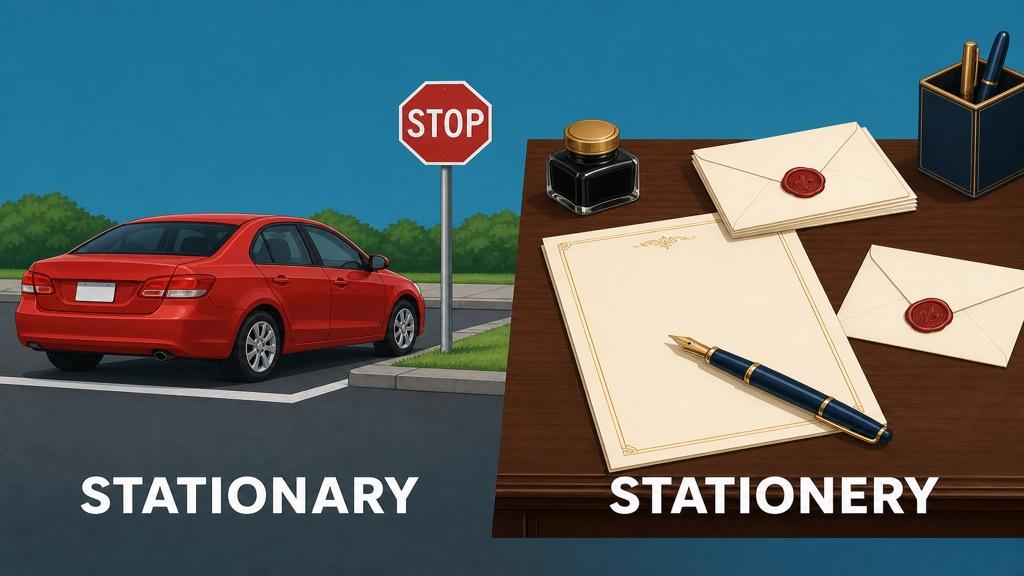
"Stationary" means not moving or fixed in place. "Stationery" refers to writing materials such as paper, envelopes, and pens. The two words are spelled almost identically, differing only in one letter, but they have completely unrelated meanings.
- Stationary (with an a) = standing still, not moving. "The car remained stationary at the red light."
- Stationery (with an e) = writing supplies. "She bought new stationery for her thank-you notes."
Why Do People Confuse Stationary and Stationery?
Both words are pronounced the same way, which makes them homophones. In speech, there is zero difference. The confusion only surfaces in writing, where a single vowel separates them. Both also trace back to the Latin word stationarius, meaning "of a station" or "belonging to a fixed position." Medieval booksellers who operated from a fixed market stall, rather than traveling to sell goods, were called "stationers." The writing supplies they sold became known as "stationery." The shared root makes the mix-up feel almost inevitable, but the meanings have been distinct for centuries.
How Do You Use "Stationary" Correctly?
"Stationary" is an adjective that describes something that is not moving or not intended to be moved. If the subject is staying in one place, "stationary" is the right word.
When Should You Use "Stationary" in a Sentence?
Use "stationary" whenever you're describing a lack of movement or a fixed position:
- "The train was stationary for twenty minutes due to a signal fault."
- "A stationary front brought three days of rain."
- "The security camera is mounted in a stationary position."
- "Cyclists should check for stationary vehicles before opening a door."
What Are Common Mistakes With "Stationary"?
The most frequent error is using "stationery" (the writing-supplies word) when describing something that isn't moving:
- Wrong: "The boat was stationery in the harbor."
- Right: "The boat was stationary in the harbor."
If you're describing something that is still, stopped, or fixed, you always want the -ary ending.
Does "Stationary" Have Other Meanings?
Beyond the literal "not moving" sense, "stationary" can describe things that don't change over time. In statistics, a "stationary process" is one whose statistical properties remain constant. In weather forecasting, a "stationary front" is a boundary between air masses that isn't advancing in either direction. In every case, the core idea is the same: something that stays put.
How Do You Use "Stationery" Correctly?
"Stationery" is a noun that refers to materials used for writing, particularly paper, envelopes, cards, and sometimes pens or other desk supplies. If you're talking about something you write on or with, "stationery" is the right choice.
When Should You Use "Stationery" in a Sentence?
Use "stationery" when referring to writing materials, office supplies, or products sold by a stationer:
- "The company ordered custom stationery with its new logo."
- "She keeps a drawer of elegant stationery for personal letters."
- "The wedding stationery included invitations, RSVP cards, and menu cards."
- "He wandered through the stationery aisle looking for a notebook."
What About "Stationery" in a Business Context?
In professional settings, "stationery" often refers to branded materials: letterheads, business cards, envelopes, and compliment slips. A "stationery set" typically means a coordinated collection of paper and envelopes. If your company has a "stationery budget," it covers writing and printing supplies, not items that refuse to move.
What Is the Best Way to Remember Stationary vs Stationery?
Memory tricks make this pair easy to keep straight. Here are the most reliable ones:
- Station-a-ry, st-a-nd still. The "a" in stationary matches the "a" in "stand." If it's standing still, use the a version.
- Station-e-ry, e-nvelope. The "e" in stationery matches the "e" in "envelope." If it involves envelopes and writing supplies, use the e version.
- "e" for "e-mail's paper ancestor." Stationery is what people used before email. Both stationery and letter have an "e."
These aren't clever tricks you'll forget in a week. They link the spelling directly to the meaning, which makes them stick.
If you find memory tricks helpful for commonly confused words, you might also appreciate the mnemonic devices in our affect vs. effect guide and the its vs. it's breakdown, which uses a similar expansion test.
Does Getting Stationary vs Stationery Wrong Really Matter?
In a casual text message, probably not. But in any professional context, this kind of error signals carelessness, especially when the writing itself is the product.
How Does This Mistake Look in Professional Writing?
Consider these real-world scenarios:
- Company website: "Browse our premium stationary collection." A stationery brand that misspells its own product category undermines its credibility immediately.
- Business letter: "Please find enclosed our corporate stationery." Correct, and it reinforces the impression of a detail-oriented company. Swap in "stationary" and that impression evaporates.
- Resume or cover letter: "Managed the office stationary budget." Hiring managers notice this kind of slip, particularly when attention to detail is part of the job description.
- Wedding invitations: "Custom stationary for your special day." Guests who know the difference will notice. And in the wedding industry, where aesthetics and polish are everything, it's a costly error.
Can Grammar Tools Catch This Error?
Standard spell checkers will not flag this mistake because both "stationary" and "stationery" are correctly spelled English words. The error is about meaning, not spelling. You need a tool that understands context. ShyEditor catches contextual errors like these automatically by analyzing what you mean, not just what you typed. It will flag "stationary" when the surrounding sentence is clearly about paper and envelopes.
If you're working on tightening up your writing more broadly, our self-editing checklist covers the most common errors to watch for before you hit publish, and our guide on how to improve writing skills goes deeper into building long-term habits.
Quick Reference: Stationary vs Stationery
| Word | Meaning | Memory Trick | Example |
|---|---|---|---|
| Stationary (a) | Not moving, fixed in place | "a" for "stand" | The bus was stationary at the stop. |
| Stationery (e) | Writing materials, paper supplies | "e" for "envelope" | She ordered personalized stationery. |
Practice Sentences
Test yourself - which is correct?
- "The security guard stood _____ at the entrance." - stationary (not moving)
- "I need to restock the office _____." - stationery (writing supplies)
- "The satellite appeared _____ in the night sky." - stationary (fixed in position)
- "The _____ shop on the corner sells beautiful notebooks." - stationery (a shop selling writing materials)
- "Traffic was _____ for over an hour on the motorway." - stationary (not moving)
- "Her personal _____ had her initials embossed in gold." - stationery (personalized writing paper)
Write With Confidence
Stationary vs stationery is one of those pairs that spell checkers miss because both spellings are valid words. The only defense is knowing the difference, or using a tool that understands context. ShyEditor catches these homophone mix-ups automatically, whether you're writing a business proposal, a blog post, or a personal letter. Try it free: https://www.shyeditor.com