
- Published on
Hole vs. Whole: What Is the Difference?
- Authors

- Name
- Tony
- @shyeditor
What Is the Difference Between Hole and Whole?
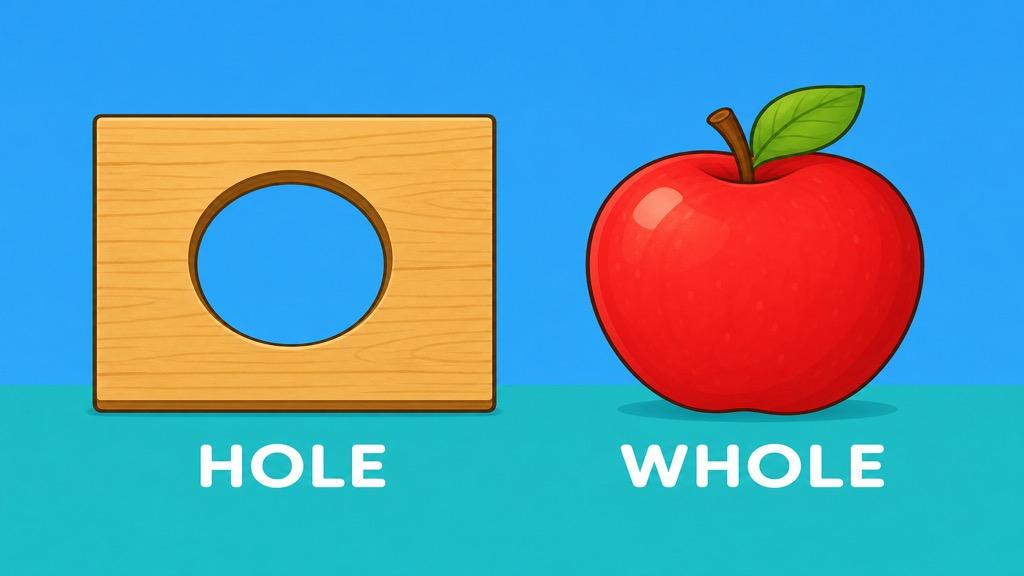
"Hole" means an opening, gap, or hollow space. "Whole" means entire, complete, or undivided. They are pronounced the same, but a hole is something missing and whole is something complete, which makes them near opposites in meaning.
- Hole: "There is a hole in my sock." (An opening.)
- Whole: "He ate the whole pizza." (The entire thing.)
The simple rule: if you can replace the word with "entire," "complete," or "all of," use "whole" with a "w." If you mean a gap or opening, use "hole."
Why Do People Confuse Hole and Whole?
The two words are homophones, pronounced identically, and the silent "w" in "whole" gives no clue when you say it out loud. Because "hole" is the shorter, more common spelling, it gets used by default, producing errors like "the hole story" instead of "the whole story." The fix is to remember that "whole" carries the silent "w" of "with everything included."
How Do You Use Hole Correctly?
"Hole" is a noun meaning an opening, an empty space, or a hollow place. It can describe a literal gap or a figurative one.
When Does Hole Mean a Literal Opening?
Use "hole" for a physical gap or hollow:
- "The dog dug a hole in the yard."
- "Water leaked through a hole in the roof."
- "She found a hole in her pocket."
- "The golfer sank the ball in one hole."
Can Hole Be Used Figuratively?
Yes. "Hole" appears in many figurative phrases, all built on the idea of a gap or trap:
- "There is a hole in your argument."
- "He dug himself into a hole."
- "I need a hole in my schedule for this."
Common set phrases include "ace in the hole," "money pit" expressions like "burning a hole in your pocket," and "hole up" meaning to hide away.
How Do You Use Whole Correctly?
"Whole" is usually an adjective meaning entire, complete, or full, and it can also be a noun meaning the full amount or the complete thing. The silent "w" sets it apart from "hole."
When Does Whole Mean Entire or Complete?
Use "whole" when nothing is missing:
- "She read the whole book in a day."
- "The whole family came to dinner."
- "I spent the whole afternoon writing."
- "Tell me the whole truth."
When Is Whole Used as a Noun?
"Whole" also names the complete thing or total:
- "The whole is greater than the sum of its parts."
- "Taken as a whole, the plan works."
- "She sold it as a whole, not in pieces."
If you mean all of something, complete and undivided, "whole" is the word, never "hole."
What Is the Easiest Way to Remember the Difference?
Decide by meaning. If you mean the entire thing, complete with nothing missing, it is "whole." If you mean a gap or opening, it is "hole." Because the two words are near opposites, checking which meaning you intend settles it every time.
Is There a Quick Test for The Whole Story vs The Hole Story?
Yes. "The whole story" means the complete, entire account, so it takes the "w" spelling that means complete. There is no such thing as "the hole story" unless you are literally describing a story about a hole. When you mean all of it, reach for "whole." This kind of meaning-based check is exactly what a good self-editing checklist is built to catch.
How Do You Handle These Words in Formal Writing?
In essays, fiction, and professional documents, swapping these two signals carelessness. Writing "the company spent the hole budget" or "there is a whole in the fence" tells an attentive reader the wrong homophone slipped through. Because the two words are near opposites, the error can also flip your meaning entirely, which is why getting it right matters. Our guide to how to improve your writing skills covers the habits that keep slips like this off the page.
Can Grammar Tools Catch This Mistake?
A standard spell checker accepts both spellings as valid words, so it will not flag "the hole truth" or "a whole in the wall." The error is contextual. ShyEditor reads the meaning of your sentence and flags when "hole" appears where you mean entire, or when "whole" shows up where you mean an opening. If you are revising a manuscript, our how to edit your own writing guide pairs well with a tool that catches what tired eyes miss.
Quick Reference: Hole vs Whole
| Word | Part of Speech | Meaning | Example |
|---|---|---|---|
| Hole | Noun | An opening, gap, or hollow | "A hole in the wall." |
| Whole | Adjective / noun | Entire, complete, undivided | "The whole day." |
Practice Sentences
Test yourself, which word is correct?
- "He spent the _____ weekend editing his novel." - whole (entire)
- "A mouse slipped through a _____ in the wall." - hole (opening)
- "Please tell me the _____ truth." - whole (complete)
- "The flat tire had a _____ from a nail." - hole (opening)
- "The _____ team celebrated the win." - whole (entire)
Write With Confidence
Homophones like hole and whole sound identical but mean nearly opposite things, and the wrong one can reverse what you intended to say. ShyEditor catches these contextual slips before they reach the page, whether you are writing a novel, an essay, or an everyday email. Try it free: https://www.shyeditor.com