
- Published on
Weather vs. Whether: What Is the Difference?
- Authors

- Name
- Tony
- @shyeditor
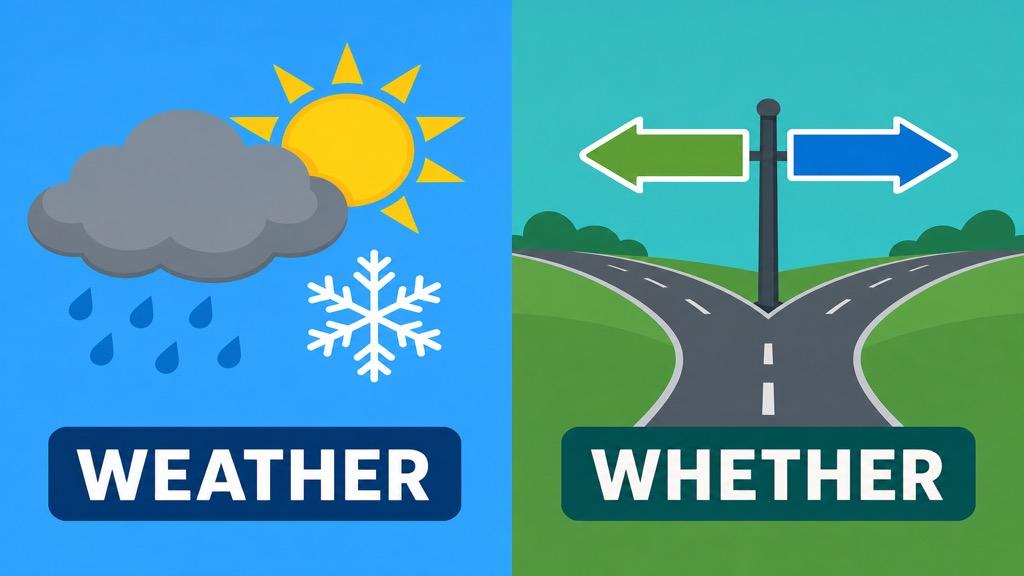
What Is the Difference Between Weather and Whether?
"Weather" refers to atmospheric conditions like rain, sun, and wind. "Whether" is a conjunction that introduces a choice between two or more alternatives. They sound alike but do completely different jobs in a sentence.
- Weather: "The weather is cold today." (Atmospheric conditions.)
- Whether: "I cannot decide whether to go." (Introducing a choice.)
The simple rule: if you can replace the word with "rain or shine" or "climate," use "weather." If you can replace it with "if" or are weighing options, use "whether."
Why Do People Confuse Weather and Whether?
The two words are near-homophones, separated only by the soft "h" sound that often disappears in speech. Because "weather" is the more concrete, everyday word, it gets written by default, producing errors like "I do not know weather to stay." The fix is to ask whether the sentence is about a choice or about the sky.
How Do You Use Weather Correctly?
"Weather" is most often a noun naming the state of the atmosphere, but it can also be a verb meaning to endure or to wear down over time. Both uses are tied to the physical world.
When Is Weather a Noun?
Use "weather" for any description of atmospheric conditions:
- "The weather turned stormy by evening."
- "We checked the weather before the hike."
- "Bad weather delayed the flight."
- "She loves cold weather."
Can Weather Be a Verb?
Yes. As a verb, "weather" means to come through something difficult, or to be worn by exposure:
- "They weathered the recession without layoffs."
- "The old barn had weathered to a soft grey."
- "He weathered the criticism calmly."
In every case, "weather" connects back to climate, endurance, or exposure, never to a choice between options.
How Do You Use Whether Correctly?
"Whether" is a conjunction that introduces alternatives or an indirect question. It signals that two or more possibilities are in play.
When Does Whether Introduce a Choice?
Use "whether" when you are weighing options, often paired with "or":
- "I do not know whether to laugh or cry."
- "Ask her whether she is coming."
- "It depends on whether the funding comes through."
- "He wondered whether he had locked the door."
Can Whether Replace If?
Often, yes. In indirect questions, "whether" and "if" are usually interchangeable: "Tell me whether you agree" and "Tell me if you agree" both work. But "whether" is the better choice in formal writing and is required before "or not" and before an infinitive: "whether or not to stay," "whether to leave." If you can swap in "if" and the sentence still makes sense, you almost certainly want "whether," not "weather."
What Is the Easiest Way to Remember the Difference?
Test the meaning, and use the spelling as a backup. If the sentence is about a choice, use "whether," which you can swap for "if." If it is about rain, sun, or storms, use "weather." As a spelling cue, "whether" begins with "wh-" like the question words "which" and "what," and like them it sets up a choice or question.
Is There a Quick Test for Whether or Not?
Yes. The phrase is always "whether or not," never "weather or not." Because "or not" presents the second half of a choice, it can only follow the conjunction "whether." If you see "or not" coming after the word, you need the spelling with the "h" and no "ea." This kind of fixed-phrase check is exactly what a good self-editing checklist is designed to automate.
How Do You Handle These Words in Formal Writing?
In essays, fiction, and professional documents, swapping these two stands out immediately. "I am not sure weather this is correct" tells a careful reader that the draft slipped past a final review. Because the words belong to different parts of speech, the error also makes the sentence briefly unparseable, forcing the reader to backtrack. Our guide to how to improve your writing skills covers the revision habits that keep mistakes like this off the page.
Can Grammar Tools Catch This Mistake?
A basic spell checker accepts both words, since each is spelled correctly, so it will not flag "I wonder weather to call." The error is contextual. ShyEditor reads the structure of your sentence and flags when "weather" appears where a conjunction is needed, or when "whether" shows up where you mean the sky. If you are revising a longer piece, pair it with our how to edit your own writing guide.
Quick Reference: Weather vs Whether
| Word | Part of Speech | Meaning | Example |
|---|---|---|---|
| Weather | Noun / verb | Atmospheric conditions; to endure | "The weather is sunny." |
| Whether | Conjunction | Introduces a choice or alternative | "Decide whether to go." |
Practice Sentences
Test yourself, which word is correct?
- "I cannot tell _____ she is joking." - whether (a choice)
- "The _____ ruined our picnic plans." - weather (conditions)
- "We will go _____ or not it rains." - whether (fixed phrase)
- "The fence had _____ over many winters." - weathered (endured/worn)
- "Check the _____ forecast for tomorrow." - weather (conditions)
Write With Confidence
Weather and whether sound almost identical but do entirely different jobs, and the wrong one stops your reader cold. ShyEditor catches these contextual slips before they reach the page, whether you are writing a novel, an essay, or an everyday email. Try it free: https://www.shyeditor.com