
- Published on
Patience vs. Patients: What Is the Difference?
- Authors

- Name
- Tony
- @shyeditor
What Is the Difference Between Patience and Patients?
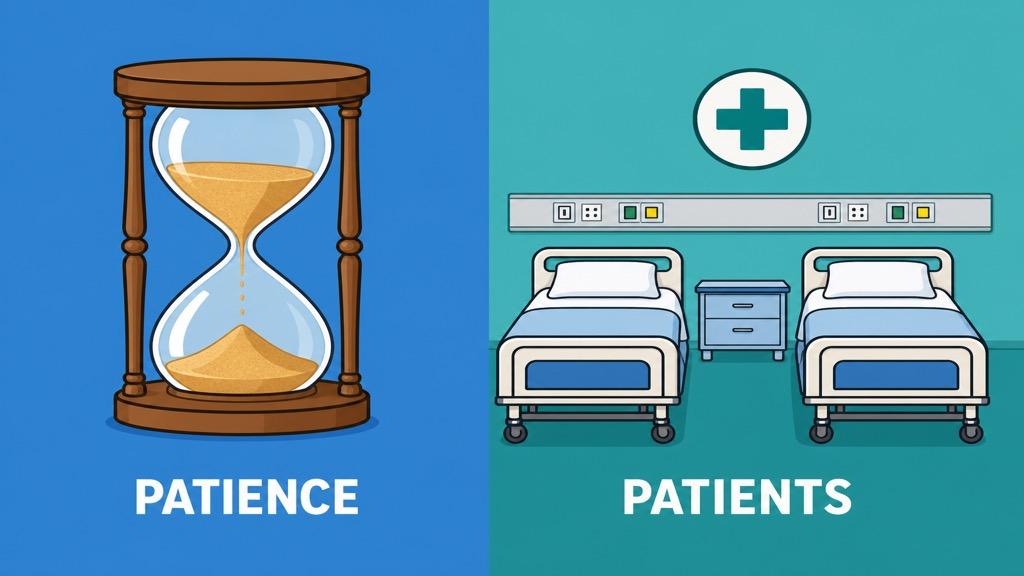
"Patience" is an uncountable noun meaning the ability to wait calmly without getting upset. "Patients" is the plural of "patient," meaning people receiving medical care. They are pronounced almost identically, but one is a quality and the other is a group of people.
- Patience: "Teaching requires a lot of patience." (Calm endurance.)
- Patients: "The doctor saw twelve patients today." (People under care.)
The simple rule: if you mean the calm quality of waiting, use "patience" ending in "-ence." If you mean more than one person being treated, use "patients" ending in "-ents."
Why Do People Confuse Patience and Patients?
The two words are near-homophones, pronounced so similarly that the ear cannot tell them apart, and both come from the same Latin root meaning to suffer or endure. The difference is entirely in spelling and meaning: "patience" is an abstract quality, while "patients" is a countable group of people. The fix is to ask whether you can count them. You can have many patients, but you cannot have "many patiences."
How Do You Use Patience Correctly?
"Patience" is a noun naming the capacity to accept delay, trouble, or suffering without becoming annoyed. It is uncountable, so it has no plural form in everyday use.
When Does Patience Mean Calm Endurance?
Use "patience" for the quality of staying calm:
- "Raising children takes endless patience."
- "He lost his patience in traffic."
- "Thank you for your patience while we fix this."
- "Patience is a virtue."
What Phrases Commonly Use Patience?
Several fixed expressions take "patience":
- "Try someone's patience."
- "The patience of a saint."
- "My patience is wearing thin."
If you mean the calm ability to wait, "patience" with "-ence" is always correct. Building this quality is part of any sustainable daily writing routine, where progress comes from showing up steadily rather than rushing.
How Do You Use Patients Correctly?
"Patients" is the plural of "patient," a noun meaning a person receiving medical treatment. Unlike "patience," it is countable, so you can have one patient or many patients.
When Does Patients Mean People Under Care?
Use "patients" for more than one person being treated:
- "The nurse checked on her patients."
- "Several patients were waiting in the lobby."
- "The hospital admitted forty patients."
- "Doctors must listen to their patients."
How Does Patient Work as an Adjective?
Note that "patient" without an "s" can also be an adjective meaning calm and tolerant, which is where its link to "patience" becomes clear:
- "Please be patient with the new staff."
- "She is patient with beginners."
So "patient" the adjective describes someone who has "patience," while "patients" the noun names people in medical care. Same spelling for the singular adjective and singular noun, but only the noun adds an "s" for the plural.
What Is the Easiest Way to Remember the Difference?
Decide by what you mean. If you are describing the calm ability to wait, it is "patience." If you mean people receiving medical care, it is "patients." The two split cleanly along a quality-versus-people line, so naming what you mean settles the spelling.
Is There a Quick Test for Patience vs Patients?
Yes. Ask whether you can put a number in front of the word. You can say "three patients" but never "three patience," because patience is uncountable while patients are people you can count. If a number fits, it is "patients." If you mean the calm quality, it is "patience." A careful pass with a proofreading checklist is the surest way to catch this before it reaches a reader.
How Do You Handle These Words in Formal Writing?
In essays, medical writing, and professional documents, mixing these up signals carelessness, and the error is especially noticeable in healthcare contexts. Writing "the clinic thanks you for your patients" when you mean "your patience" sends the wrong message entirely. Because the two words split along a quality-versus-people line, choosing the right one keeps your meaning exact. Our guide to how to improve your writing skills covers the proofreading habits that keep slips like this off the page.
Can Grammar Tools Catch This Mistake?
A standard spell checker accepts both spellings as valid words, so it will not flag "thank you for your patients" or "the doctor saw many patience." The error is contextual. ShyEditor reads the meaning of your sentence and flags when "patients" appears where you mean the quality of waiting, or when "patience" shows up where you mean people under care. If you are polishing an essay or a manuscript, our how to edit your own writing guide pairs well with a tool that catches what tired eyes miss.
Quick Reference: Patience vs Patients
| Word | Part of Speech | Meaning | Example |
|---|---|---|---|
| Patience | Noun (uncountable) | The ability to wait calmly | "She showed great patience." |
| Patients | Noun (plural) | People receiving medical care | "The ward had six patients." |
Practice Sentences
Test yourself, which word is correct?
- "Thank you for your _____ during the delay." - patience (calm waiting)
- "The surgeon operated on three _____ today." - patients (people under care)
- "Learning an instrument requires real _____." - patience (endurance)
- "All the _____ were discharged by evening." - patients (people under care)
- "His _____ finally ran out." - patience (calm quality)
Write With Confidence
Near-homophones like patience and patients sound the same but mean entirely different things, and the wrong one can confuse your reader or change your message. ShyEditor catches these contextual slips before they reach the page, whether you are writing a novel, an essay, or a professional report. Try it free: https://www.shyeditor.com