
- Published on
Loose vs. Lose: Why This Spelling Mix-Up Is So Common
- Authors

- Name
- Tony
- @shyeditor
What Is the Difference Between Loose and Lose?
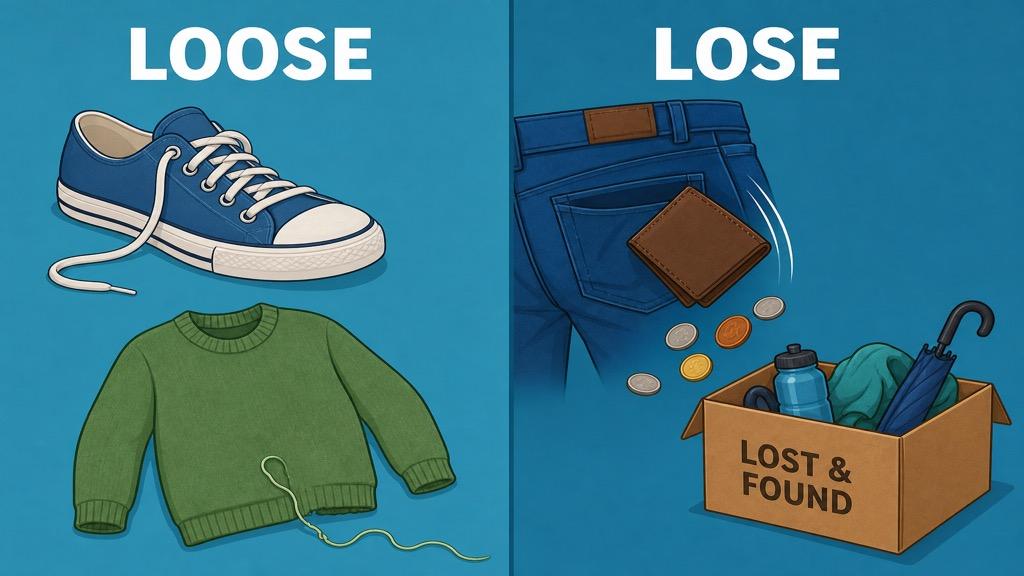
"Loose" means not tight or not secured. "Lose" means to misplace something or fail to win. They look similar on the page, but they have completely different meanings, different pronunciations, and different roles in a sentence. "Loose" rhymes with "goose." "Lose" rhymes with "choose."
- Loose = not tight, free, unfastened. "The screw is loose."
- Lose = to misplace or fail to keep. "Don't lose your keys."
Why Do People Confuse Loose and Lose?
Unlike most word pairs on grammar lists, loose and lose aren't homophones - they don't even sound the same. The confusion is purely visual. Both words share the letters L-O-S-E, with "loose" just adding an extra O. When typing quickly, your fingers produce "loose" when you mean "lose" (or vice versa) because the words are only one letter apart. Your brain sees enough of the right letters to skip the check, and the error slips through.
How Do You Use "Loose" Correctly?
"Loose" is primarily an adjective meaning not tight, not fixed, or not contained. It describes a physical state. If you can replace the word with "tight" and the sentence still makes grammatical sense (even if the meaning flips), "loose" is likely the right choice.
When Should You Use "Loose" in a Sentence?
As an adjective (not tight or not secured):
- "These pants are too loose around the waist."
- "One of the tiles on the roof is loose."
- "She wore her hair loose instead of in a ponytail."
- "The dog got loose and ran down the street."
As a verb (to release or set free):
- "They loosed the arrows at the approaching army."
- "The farmer loosed the cattle into the pasture."
This verb form is less common in everyday writing, but you'll encounter it in literary and historical contexts.
What Are Common Mistakes With "Loose"?
The most frequent error is writing "loose" when "lose" is intended:
- Wrong: "I don't want to loose this opportunity."
- Right: "I don't want to lose this opportunity."
The quick test: does the sentence involve something not being tight or being set free? If it's about misplacing something or failing, you need "lose."
How Do You Use "Lose" Correctly?
"Lose" is a verb meaning to misplace, to fail to win, or to no longer have something. It always describes an action or process, never a physical state. If you can replace the word with "misplace" or "fail to keep" and the sentence still works, "lose" is correct.
What Are Examples of "Lose" in a Sentence?
To misplace:
- "I always lose my sunglasses."
- "Try not to lose the receipt."
To fail to win:
- "They're going to lose the game if they don't score soon."
- "She hates to lose at anything."
To no longer have:
- "You'll lose your deposit if you cancel."
- "He started to lose his patience."
- "The company could lose millions if the deal falls through."
How Do You Conjugate "Lose"?
Unlike "loose," which stays the same in most forms, "lose" changes with tense:
- Present: lose / loses ("I lose things constantly." / "She loses her temper easily.")
- Past: lost ("He lost his wallet yesterday.")
- Present participle: losing ("We're losing time.")
- Past participle: lost ("They've lost three games in a row.")
Notice that the past tense is "lost," not "losed" or "loosed." If you're writing about something that already happened, "lost" is almost always the word you need.
What Is the Fastest Way to Tell Loose and Lose Apart?
Two checks:
- Does it mean "not tight" or "set free"? Use loose (two O's, rhymes with goose). "The knot is loose."
- Does it mean "misplace" or "fail to win"? Use lose (one O, rhymes with choose). "Don't lose your ticket."
What Memory Tricks Help With Loose vs Lose?
- Loose has two O's - the extra O makes it looser, like the word itself is stretched out.
- Lose lost an O - it lost a letter, just like its meaning.
- Pronunciation settles it: "loose" rhymes with "goose" (the OO sound), "lose" rhymes with "choose" (the OOZ sound). If you say the sentence out loud with both pronunciations, the right word becomes obvious.
- "A loose goose" vs "you lose, you choose." Match the rhyme to the meaning.
Does Getting Loose vs Lose Wrong Actually Matter?
This is one of the most visible spelling errors online. Because the mistake is so common in social media comments, forum posts, and quick messages, many readers have developed an almost automatic reflex for spotting it.
How Does This Mistake Look in Professional Writing?
Consider these scenarios:
- Marketing email: "Don't loose out on this limited-time offer!" The call to action - the most important sentence in the email - contains a spelling error.
- Sports journalism: "The team is expected to loose tonight's match." Readers will notice immediately because "lose" and "win" are the core vocabulary of the subject.
- Business memo: "We stand to loose significant market share." An error in a sentence about financial risk undermines the seriousness of the message.
Unlike some grammar errors that require specialized knowledge to spot, almost every fluent English reader will catch a loose/lose swap.
Can Grammar Tools Catch This Mistake?
Basic spell checkers won't catch it because both "loose" and "lose" are correctly spelled. The error is a matter of context, not spelling. Shy Editor analyzes what you mean, not just what you typed, and flags when you've used one where the other belongs.
If you find yourself second-guessing similar word pairs, our guide on then vs than covers another commonly swapped pair where both words are valid but mean very different things.
How Do You Handle Related Words Like "Loss" and "Loosely"?
The loose/lose confusion sometimes extends to their related forms. Here's how the word families break down.
What Is the Difference Between "Loss" and "Loose"?
"Loss" is the noun form of "lose." It refers to the act or instance of losing something:
- "The loss of the contract was a setback."
- "She felt a deep sense of loss."
"Loosely" is the adverb form of "loose":
- "The rules are loosely enforced."
- "He loosely tied the knot."
These forms don't get confused as often, but knowing the word families helps reinforce which root word you need.
What About "Loosen" vs "Losen"?
"Loosen" is a real word meaning to make something less tight:
- "Loosen the bolts before removing the panel."
- "She loosened her grip."
"Losen" is not a word. If you're writing about making something less tight, always use "loosen." If you're writing about failing to keep something, the verb is "lose" (past tense: "lost").
How Do You Use Loose and Lose in Formal Writing?
The rules are the same in every register, but formal writing demands tighter proofreading. Since spell check won't catch the error, you need to verify manually or use a context-aware tool.
What About Academic and Business Contexts?
In academic writing:
- "Participants were asked not to lose focus during the trial."
- "The loose definition of the term led to inconsistent results."
- "Data integrity can be lost if protocols aren't followed."
In business contexts:
- "We cannot afford to lose this client."
- "The contract language is too loose to be enforceable."
- "Tighten up the loose requirements before the next sprint."
Notice that in business writing, "loose" often appears metaphorically (loose requirements, loose definition) rather than describing something physically unfastened.
Quick Reference: Loose vs Lose
| Word | Meaning | Pronunciation | Example |
|---|---|---|---|
| Loose | Not tight, free | Rhymes with "goose" | The lid is loose. |
| Lose | Misplace, fail to win | Rhymes with "choose" | Don't lose hope. |
Practice Sentences
Test yourself - which is correct?
- "The handle feels _____. Can you tighten it?" - loose (not tight)
- "I'm afraid we'll _____ the account if we don't act fast." - lose (fail to keep)
- "Her _____ interpretation of the rules caused problems." - loose (not strict)
- "Did you _____ your phone again?" - lose (misplace)
- "The horse broke _____ from the stable." - loose (free, unfastened)
- "You have nothing to _____." - lose (nothing to fail to keep)
Write With Confidence
Loose vs lose is one of the internet's most common spelling mix-ups, and spell check won't save you. Shy Editor catches context-dependent errors like these automatically, so you can write faster without worrying about which O to drop. Try it free: https://www.shyeditor.com