
- Published on
Your vs. You're: How to Tell Them Apart Every Time
- Authors

- Name
- Tony
- @shyeditor
What Is the Difference Between Your and You're?
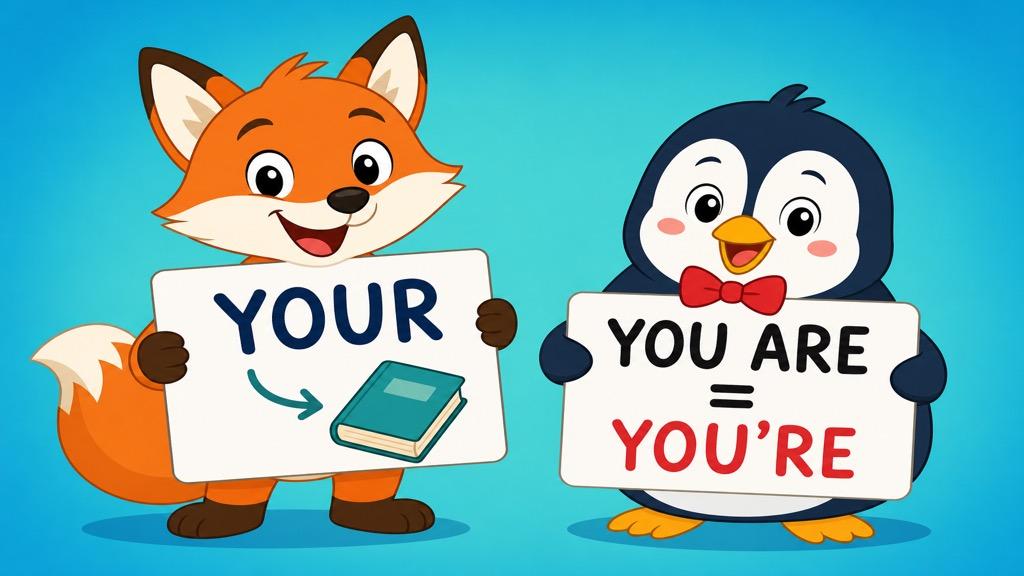
"Your" shows possession, and "you're" is a contraction of "you are." That's the entire rule. If you can replace the word with "you are" and the sentence still makes sense, use "you're." If not, use "your." Despite being one of the simplest grammar rules in English, this mix-up appears constantly in emails, social media posts, and even published writing.
- Your = belonging to you. "Is this your coat?"
- You're = you are. "You're going to love this."
Why Do People Confuse Your and You're?
The two words sound identical when spoken. When you're typing quickly, your fingers reach for the familiar spelling before your brain catches up with the meaning. Autocorrect doesn't always help either, since both words are valid. The mistake happens most in fast, casual writing - texts, emails, and social media - where you're focused on the message, not the mechanics.
How Do You Use "Your" Correctly?
"Your" is a possessive determiner. It tells the reader that something belongs to or is associated with the person being addressed. If you can swap in "my" or "their" and the sentence still works grammatically, "your" is the right choice.
When Should You Use "Your" in a Sentence?
Use "your" any time you're describing something that belongs to or relates to the person you're talking to:
- "Don't forget your keys."
- "What's your opinion on this?"
- "Your presentation was excellent."
- "I saw your message this morning."
What Are Common Mistakes With "Your"?
The most frequent error is writing "you're" when ownership is intended:
- Wrong: "You're ideas are impressive."
- Right: "Your ideas are impressive."
Try replacing it with "you are": "You are ideas are impressive" makes no sense, so "you're" is wrong here.
How Do You Use "You're" Correctly?
"You're" always means "you are." The apostrophe replaces the missing "a" in "are." If you can expand the word to "you are" and the sentence still reads naturally, "you're" is correct. If the expansion sounds wrong, you need "your" instead.
What Are Examples of "You're" in a Sentence?
- "You're welcome to join us." (You are welcome to join us.)
- "I think you're making the right call." (I think you are making the right call.)
- "You're not going to believe this." (You are not going to believe this.)
- "Tell me when you're ready." (Tell me when you are ready.)
Why Does the Apostrophe Test Always Work?
The apostrophe in "you're" exists for one reason only: it marks where the letter "a" was removed when "you are" was shortened. This means "you're" can always be expanded back to "you are" without changing the meaning. No possessive form of "your" works this way. That makes the expansion test 100% reliable, every time, with no exceptions.
What Is the Fastest Way to Tell Your and You're Apart?
Two checks, two seconds:
- Can you expand it to "you are"? Use you're. "You're late" = "You are late."
- Does it show that something belongs to someone? Use your. "Your car" = the car belonging to you.
What Memory Tricks Help With Your vs You're?
- "You're" has an apostrophe - apostrophes in contractions always signal missing letters. If there's an apostrophe, try expanding it.
- "Your" ends in R, like "possessoR" - both are about ownership.
- The "you are" swap - this is the fastest and most reliable check. Read the sentence out loud with "you are" in place of the word. If it sounds right, use "you're." If it sounds wrong, use "your."
Does Getting Your vs You're Wrong Actually Matter?
In a group chat, nobody will stop to correct you. But the moment your writing represents you professionally, this mistake starts costing you credibility.
How Does This Mistake Look in Professional Settings?
Consider these scenarios:
- Job application: "I believe your the right fit for this role." The hiring manager sees a basic grammar error before they even reach your qualifications.
- Client proposal: "Your going to see significant ROI in Q3." A small error, but it signals carelessness in a document meant to build confidence.
- Team-wide email: "Please submit you're timesheets by Friday." Dozens of colleagues notice, and nobody says anything, but everyone registers it.
The your/you're distinction is taught in elementary school, which means getting it wrong in professional writing stands out more than obscure grammar mistakes would.
Can Grammar Tools Catch This Mistake?
Standard spell checkers won't flag it because both "your" and "you're" are correctly spelled words. The error is about context, not spelling. You need a tool that understands what you mean, not just what you typed. Shy Editor catches these contextual errors automatically by analyzing sentence meaning rather than just checking spelling.
If you've mastered your vs you're, the next homophone pair worth nailing down is their vs there vs they're - same type of mistake, same easy fix.
How Do You Handle Your vs You're in Formal Writing?
The rules stay the same in formal writing, but errors are judged more harshly. Academic papers, business documents, and published content are expected to be polished.
What About Academic and Business Writing?
In academic writing:
- "Present your thesis statement in the first paragraph."
- "If you're citing multiple sources, use a reference list."
- "Your methodology should be replicable."
In business contexts:
- "Please confirm your availability for the meeting."
- "You're expected to submit the report by end of day."
- "We value your feedback on this proposal."
Is "Your" Ever Used in a Non-Possessive Way?
Strictly speaking, "your" is always possessive. But in casual English, it sometimes appears in phrases where the ownership is loose or idiomatic:
- "Your typical Monday morning."
- "It's not your everyday occurrence."
In these cases, "your" means something closer to "the kind of" or "a typical." It's still grammatically functioning as a possessive (the Monday morning belonging to the general "you"), just in a looser, colloquial sense. You'll see this in conversational writing but rarely in formal contexts.
Quick Reference: Your vs You're
| Word | Meaning | Test | Example |
|---|---|---|---|
| Your | Belonging to you | Replace with "my" | Your phone is ringing. |
| You're | You are | Expand to "you are" | You're doing great. |
Practice Sentences
Test yourself - which is correct?
- "_____ the first person I thought of." - You're (you are the first person)
- "Is this _____ laptop?" - your (the laptop belonging to you)
- "_____ going to need a bigger boat." - You're (you are going to need)
- "I appreciate _____ honesty." - your (honesty belonging to you)
- "_____ not wrong about that." - You're (you are not wrong)
- "What's _____ take on the new policy?" - your (the take belonging to you)
Write With Confidence
Your vs you're is one of those errors that's easy to make and impossible to hide. Shy Editor catches contextual mistakes like these before they reach your reader, whether you're drafting a quick email or polishing a formal report. Try it free: https://www.shyeditor.com