
- Published on
Accept vs. Except: What Is the Difference?
- Authors

- Name
- Tony
- @shyeditor
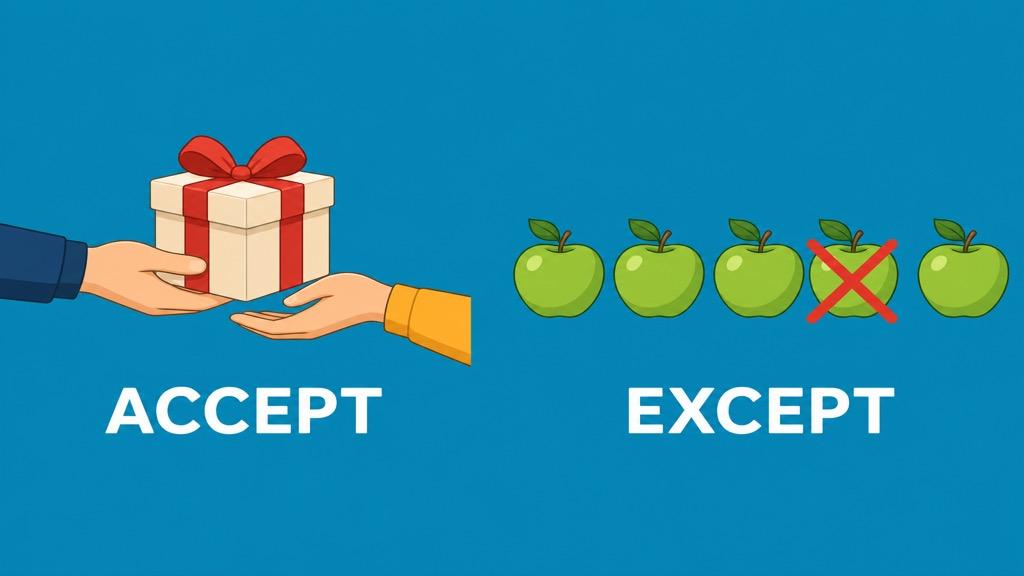
What Is the Difference Between Accept and Except?
"Accept" means to receive, agree to, or take something that is offered. "Except" means to exclude, leave out, or indicate an exception. These two words sound similar when spoken quickly, but they have opposite meanings: one is about including (taking something in), and the other is about excluding (leaving something out).
- Accept = receive or agree. "I accept your invitation."
- Except = exclude or other than. "Everyone is coming except Sarah."
This is one of the most frequently confused word pairs in English, similar to affect vs. effect and then vs. than. The words sound alike, especially in casual speech, but mixing them up in writing changes your meaning entirely.
Why Do People Confuse Accept and Except?
The confusion comes from pronunciation. In fast speech, "accept" (/əkˈsɛpt/) and "except" (/ɪkˈsɛpt/) sound nearly identical. The only difference is a subtle vowel shift in the first syllable. Both words also share the Latin root "capere" (to take): "accept" comes from "accipere" (to take toward, to receive), while "except" comes from "excipere" (to take out). So they're etymological cousins with similar sounds but opposite orientations: one takes in, the other takes out. Tools like ShyEditor catch these near-homophone errors that spell check misses entirely.
How Do You Use "Accept" Correctly?
"Accept" is always a verb. It means to receive willingly, agree to, or acknowledge something. Whenever someone takes, agrees to, or welcomes something, "accept" is the right word.
How Do You Use "Accept" to Mean Receiving Something?
The most common meaning of "accept" is to receive something that has been offered:
- "She accepted the award on behalf of the team."
- "Please accept this gift as a token of appreciation."
- "The university accepted her application."
- "He accepted the job offer without hesitation."
In each case, something is being given and someone is taking it. If you can replace the word with "receive" or "take," you need "accept."
How Do You Use "Accept" to Mean Agreeing?
"Accept" also means to agree to or consent to something:
- "Do you accept the terms and conditions?"
- "The committee accepted the proposed changes."
- "I accept your apology."
- "She finally accepted that the deadline couldn't be extended."
This usage extends to tolerating or coming to terms with a situation, as in "accepting reality" or "accepting responsibility."
What Does "Acceptable" and "Acceptance" Mean?
The adjective and noun forms reinforce the core meaning of receiving or agreeing:
- Acceptable = good enough, satisfactory. "The quality is acceptable."
- Acceptance = the act of accepting. "Her acceptance speech was moving."
- Accepted (as adjective) = generally recognized. "The accepted practice is to submit in advance."
All of these relate back to the idea of receiving, agreeing, or approving.
How Do You Use "Except" Correctly?
"Except" primarily works as a preposition or conjunction meaning "excluding" or "other than." In rare cases, it also functions as a verb meaning "to exclude." Whenever something is being left out or excluded, "except" is the right word.
How Do You Use "Except" as a Preposition?
As a preposition, "except" means "not including" or "other than":
- "Everyone passed the exam except Jake."
- "The store is open every day except Sunday."
- "I like all vegetables except Brussels sprouts."
- "The office was empty except for a single desk."
Notice that "except" always introduces what's being left out. If you can substitute "other than" or "excluding," you need "except."
How Do You Use "Except" as a Conjunction?
As a conjunction, "except" introduces a clause that states an exception:
- "I would go, except I have a meeting."
- "The plan is perfect, except it costs too much."
- "She'd agree, except she doesn't trust the data."
In these cases, "except" works similarly to "but" or "only." It introduces a reason or condition that creates an exception to what was just said.
Can "Except" Be Used as a Verb?
Yes, but this usage is rare and mostly appears in formal or legal writing. As a verb, "except" means "to exclude":
- "Present company excepted." (Present company is excluded from the criticism.)
- "All items are taxable, software excepted."
- "The court excepted certain evidence from the ruling."
You're much more likely to encounter "except" as a preposition or conjunction. But knowing the verb form exists helps you recognize it when you see phrases like "present company excepted."
What Does "Exception" and "Exceptional" Mean?
The noun and adjective forms connect to the core idea of being left out or standing apart:
- Exception = something excluded from a rule. "We'll make an exception this time."
- Exceptional = unusually good, standing apart from the norm. "Her work is exceptional."
"Exceptional" literally means "standing apart as an exception," which evolved into meaning outstanding or remarkably good.
What Is the Easiest Way to Remember Accept vs. Except?
Two reliable memory tricks will lock this down:
The First-Letter Method
- Accept starts with "ac," like "acquire." Both mean taking or receiving something.
- Except starts with "ex," like "exclude." Both mean leaving something out.
This is the simplest and most reliable mnemonic. "Ac" = acquire/take in. "Ex" = exclude/take out.
The Substitution Test
Try replacing the word with "receive/agree" or "excluding/other than":
- "I [receive] your apology" makes sense, so use "accept."
- "Everyone is coming [excluding] Sarah" makes sense, so use "except."
If neither substitution fits, you might be using the wrong word. When in doubt, run your text through ShyEditor to catch errors like this before publishing.
Why Does Getting Accept vs. Except Right Matter in Professional Writing?
Swapping these two words doesn't just look careless. It reverses your meaning:
- "We accept all applications" means you receive and consider every application.
- "We except all applications" means you exclude all applications (nobody gets considered).
In business emails, legal documents, academic papers, and client communications, this kind of error can cause real confusion. Like the loose vs. lose mix-up, the mistake is subtle enough that readers might have to reread the sentence to figure out what you actually meant.
Where Does This Mistake Show Up Most Often?
The accept/except mix-up appears frequently in:
- Emails: "I except your invitation" (wrong, should be "accept")
- Policies: "All returns are accepted on weekdays" when meant to say "except on weekends" (different sentence needed)
- Academic writing: "All participants excepted the terms" (wrong, should be "accepted")
- Legal documents: "All parties accept as noted below" (wrong if meant to say "except as noted below")
Both words are correctly spelled, so standard spell check won't flag the error. You need a context-aware editor to spot when you've used the wrong one. A thorough self-editing checklist should include scanning for near-homophones like these.
Accept vs. Except: Quick Reference Table
| Accept | Except | |
|---|---|---|
| Meaning | Receive, agree to, take in | Exclude, leave out, other than |
| Part of speech | Verb only | Preposition, conjunction, (rare) verb |
| Noun form | Acceptance | Exception |
| Adjective form | Acceptable, accepted | Exceptional |
| Memory trick | "Ac" like acquire | "Ex" like exclude |
| Example | "I accept your offer." | "Everyone except Tom." |
Can You Spot the Correct Usage? Practice Sentences
Test yourself with these sentences. Decide whether each one uses "accept" or "except" correctly:
- "She accepted the scholarship gratefully." ✅ (She received the scholarship.)
- "All assignments are due Friday, except the final project." ✅ (The final project is excluded from the Friday deadline.)
- "I can't except this level of quality." ❌ (Should be "accept," meaning tolerate or agree to.)
- "Everyone accept the manager attended the meeting." ❌ (Should be "except," meaning excluding the manager.)
- "The committee voted to accept the new policy." ✅ (They agreed to it.)
- "The restaurant serves every cuisine except Thai." ✅ (Thai is excluded.)
- "He excepted the challenge enthusiastically." ❌ (Should be "accepted," meaning he took on the challenge.)
- "Present company excepted, of course." ✅ (The rare verb usage, meaning present company is excluded from the criticism.)
If you caught all the errors, you've got this rule down. If a few tripped you up, remember: "ac" for acquire, "ex" for exclude. For another commonly swapped pair where meaning flips entirely, see affect vs. effect.
How Can You Avoid Mixing Up Accept and Except Going Forward?
Near-homophones like accept and except are tricky because they slip past spell checkers entirely. Both words are spelled correctly. The error is in choosing the wrong one for your context.
Here's a three-step process to catch these mistakes every time:
- Pause and ask: am I taking in or leaving out? If you're talking about receiving, agreeing, or welcoming, you need "accept." If you're talking about excluding or creating an exception, you need "except."
- Use the first-letter test. "Ac" = acquire (take in). "Ex" = exclude (leave out).
- Use a grammar-aware editor. Standard spell check won't flag this. A tool like ShyEditor analyzes context and catches near-homophone errors that basic checkers miss.
The accept/except distinction is one of those errors that becomes obvious once you have a system for spotting it. For a broader framework on catching word-choice mistakes during revision, see our guide on how to edit your own writing.
Write With Confidence
Accept and except are both correctly spelled words, which means spell checkers will never flag when you've used the wrong one. You need an editor that understands context. ShyEditor catches near-homophone errors like these automatically, whether you're drafting a novel, polishing an essay, or writing a client proposal. Try it free: https://www.shyeditor.com