
- Published on
Principal vs. Principle: How to Always Choose the Right One
- Authors

- Name
- Tony
- @shyeditor
What Is the Difference Between Principal and Principle?
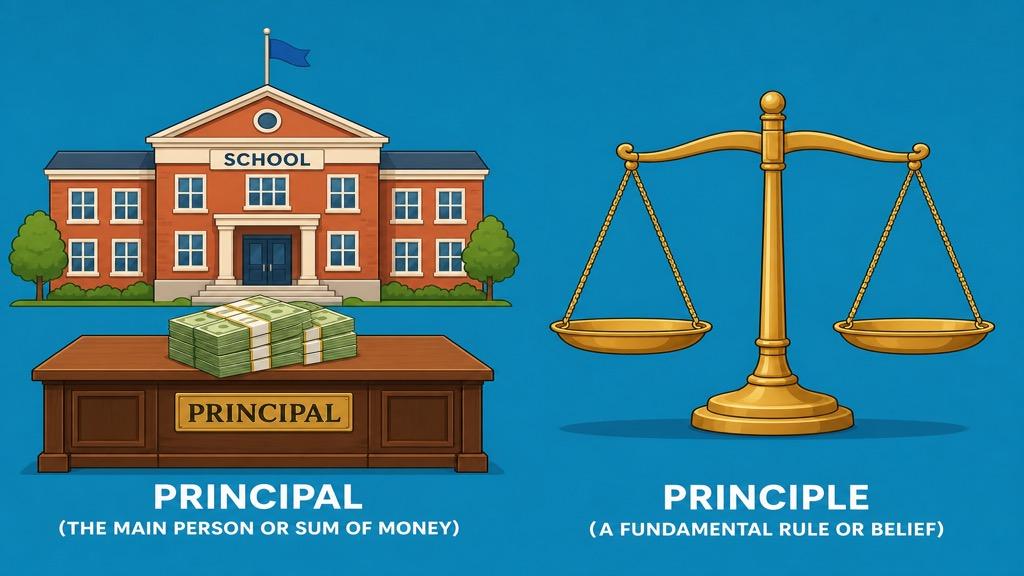
"Principal" means main, chief, or most important, and also refers to the head of a school or a sum of money. "Principle" means a fundamental truth, rule, or standard of behavior. These words sound the same but are never interchangeable. A school has a principal. Honesty is a principle.
- Principal = the main one, a school leader, or a financial sum. "The principal reason was cost."
- Principle = a rule, law, or belief. "She refused on principle."
Why Are Principal and Principle So Easy to Mix Up?
They're homophones with identical pronunciation and similar spellings. The only difference is the ending: "al" vs "le." To make things harder, both words appear frequently in formal and academic writing, where getting them wrong is most visible. Most people learn the school-principal meaning early on but encounter the broader uses of both words later, without ever solidifying which spelling goes where.
How Do You Use "Principal" Correctly?
"Principal" works as both an adjective and a noun. As an adjective, it means "main" or "most important." As a noun, it refers to a person in a leading role or a sum of money (as opposed to interest). If you can substitute "main" or "chief" and the sentence still works, "principal" is correct.
When Should You Use "Principal" as an Adjective?
Use it when describing the most important element of something:
- "The principal cause of the delay was funding."
- "Our principal concern is safety."
- "She was the principal investigator on the study."
- "The principal advantage of this approach is speed."
When Should You Use "Principal" as a Noun?
Use it when referring to a person in charge or a financial amount:
A school leader:
- "The principal announced a new dress code."
- "Students were called to the principal's office."
A leading person in a business or legal context:
- "The principals of the firm signed the agreement."
- "She's a principal at the consulting company."
A sum of money (distinct from interest):
- "The loan's principal was $200,000."
- "You're only paying interest, not reducing the principal."
How Do You Use "Principle" Correctly?
"Principle" is always a noun. It refers to a fundamental truth, a rule of conduct, or a law that explains how something works. You cannot use "principle" as an adjective. If you're describing a belief, rule, or standard, "principle" is the right choice.
When Should You Use "Principle" for Rules or Beliefs?
Use it when discussing moral standards, guiding beliefs, or ethical foundations:
- "He's a man of strong principles."
- "She refused to compromise her principles."
- "It's against my principles to lie."
- "The decision was based on principle, not convenience."
When Should You Use "Principle" for Laws or Theories?
Use it when referring to fundamental truths or scientific concepts:
- "The principle of supply and demand drives pricing."
- "Newton's principles of motion changed physics."
- "The design follows the principle of least resistance."
- "In principle, the plan should work." (Meaning: theoretically, based on the underlying rules.)
What Does "In Principle" Mean?
"In principle" means something is theoretically true or agreed upon, even if the details haven't been worked out:
- "We agreed in principle to the merger."
- "In principle, everyone should have access to healthcare."
Note: the phrase is always "in principle," never "in principal."
What Is the Best Way to Remember Principal vs Principle?
Two tricks that work every time:
- The principal is your pal. The head of the school is your "pal," and both words end in "pal." This also extends to the adjective meaning: the principal (main) thing is your "pal" because it ends in "al."
- A principle is a rule. Both "principle" and "rule" end in "le."
Can You Use a Substitution Test?
Yes. Replace the word with "main" or "rule/belief":
- "The [main] reason was cost." Works? Use principal.
- "She refused on [belief]." Works? Use principle.
- "The school [leader] called an assembly." Person in charge? Use principal.
Does Mixing Up Principal and Principle Matter?
These words appear constantly in business, academic, and legal writing, exactly the contexts where precision counts most.
How Does This Mistake Look in Professional Settings?
- Financial document: "The principle on the loan is $500,000." Wrong. You mean the sum of money, which is "principal." Writing "principle" here suggests you're talking about a rule, not money.
- Academic paper: "The principal of conservation of energy states..." Wrong. A scientific law is a "principle," not a "principal."
- Business email: "Our principle objective is growth." Wrong. You mean "main" objective, which is "principal."
Each of these errors changes the meaning of the sentence, and in professional contexts, readers will notice. Tools like ShyEditor catch these homophone mix-ups by analyzing context, not just spelling.
If you find yourself second-guessing homophones, you're not alone. Pairs like affect vs effect and your vs you're trip up even experienced writers. Our guide on how to improve your writing skills covers strategies for building confidence with these common trouble spots.
Quick Reference: Principal vs Principle
| Word | Part of Speech | Meaning | Example |
|---|---|---|---|
| Principal (adj.) | Adjective | Main, most important | The principal issue is cost. |
| Principal (noun) | Noun | School leader, key person, or money sum | The principal addressed the students. |
| Principle | Noun (always) | Rule, belief, or fundamental truth | It's a matter of principle. |
Practice Sentences
Test yourself:
- "The _____ of the school retired after 30 years." - principal (school leader, your "pal")
- "She operates on the _____ that honesty is the best policy." - principle (a belief or rule)
- "Our _____ goal this quarter is reducing costs." - principal (main, most important)
- "The _____ of gravity explains why objects fall." - principle (a scientific law)
- "He paid off the _____ on his mortgage early." - principal (the sum of money)
- "It's the _____ of the thing that bothers me." - principle (a matter of belief or standards)
Write With Confidence
Principal and principle are among the most commonly confused word pairs in professional English, and standard spell checkers miss them entirely because both are correctly spelled words. ShyEditor understands context and catches meaning-based errors like these automatically. Try it free: https://www.shyeditor.com